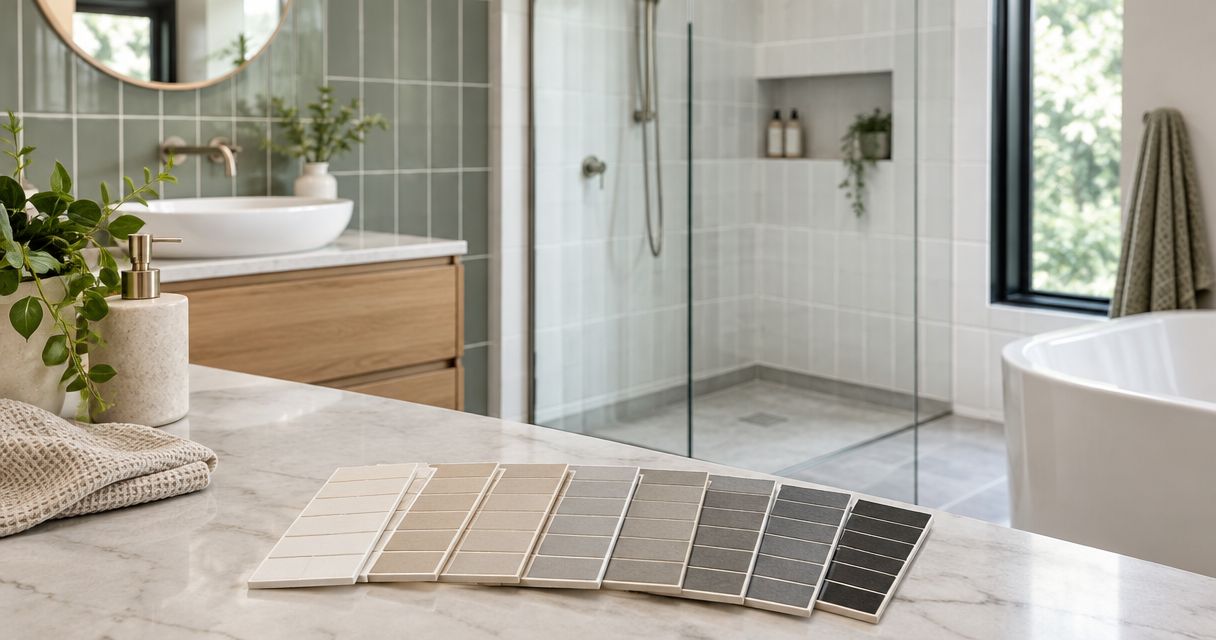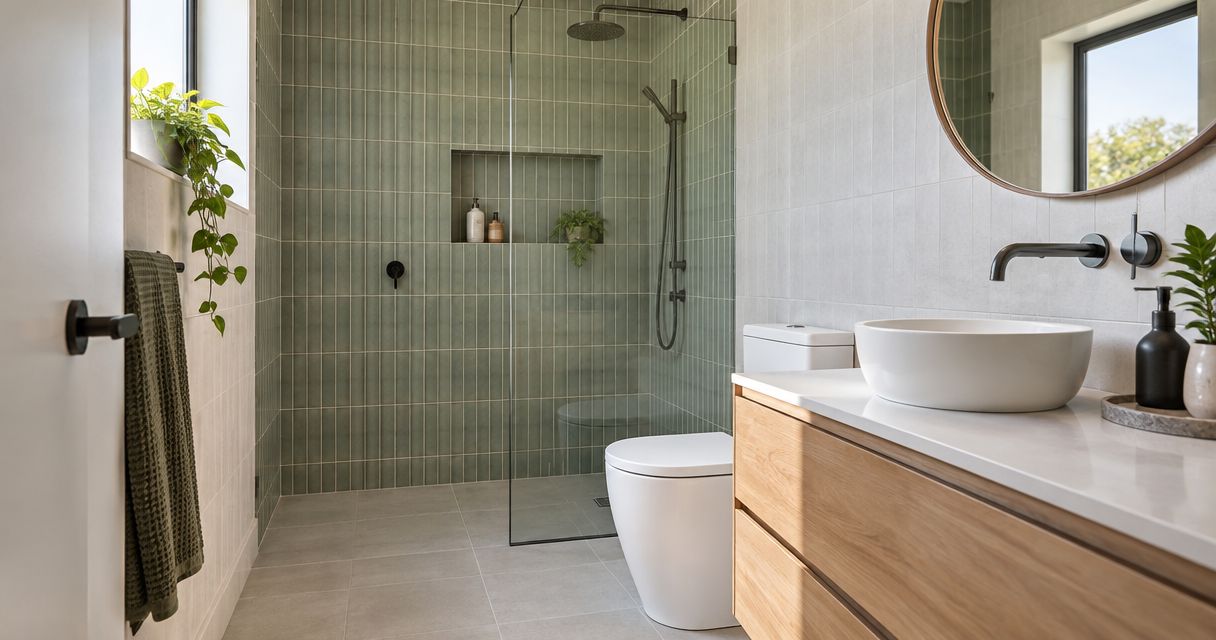
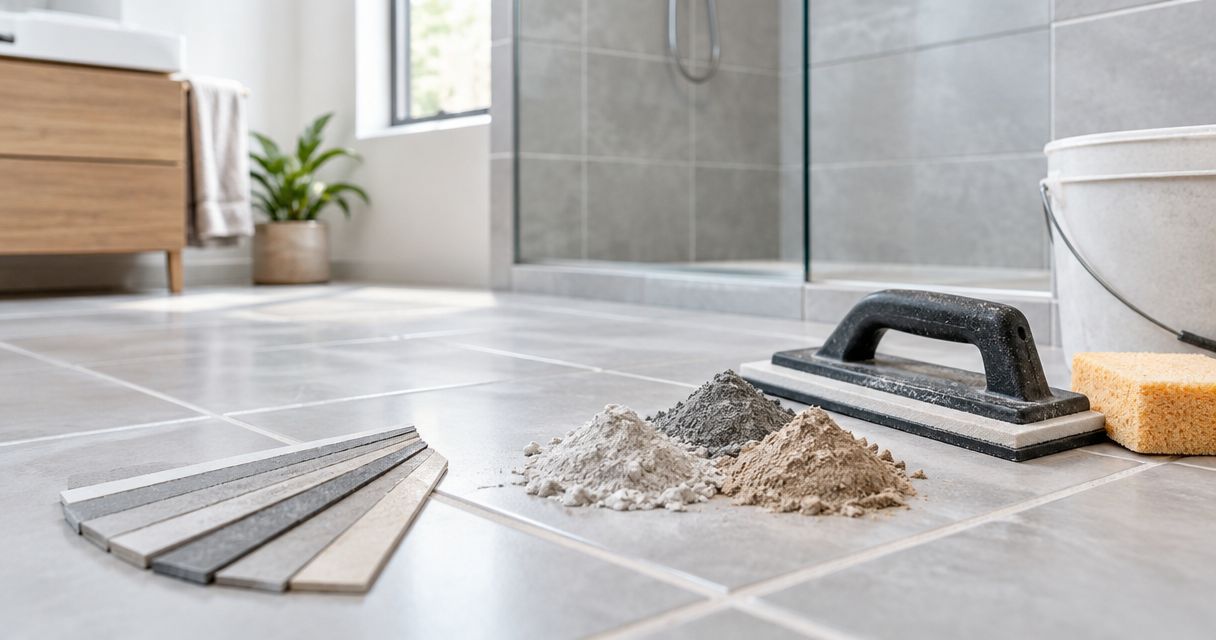
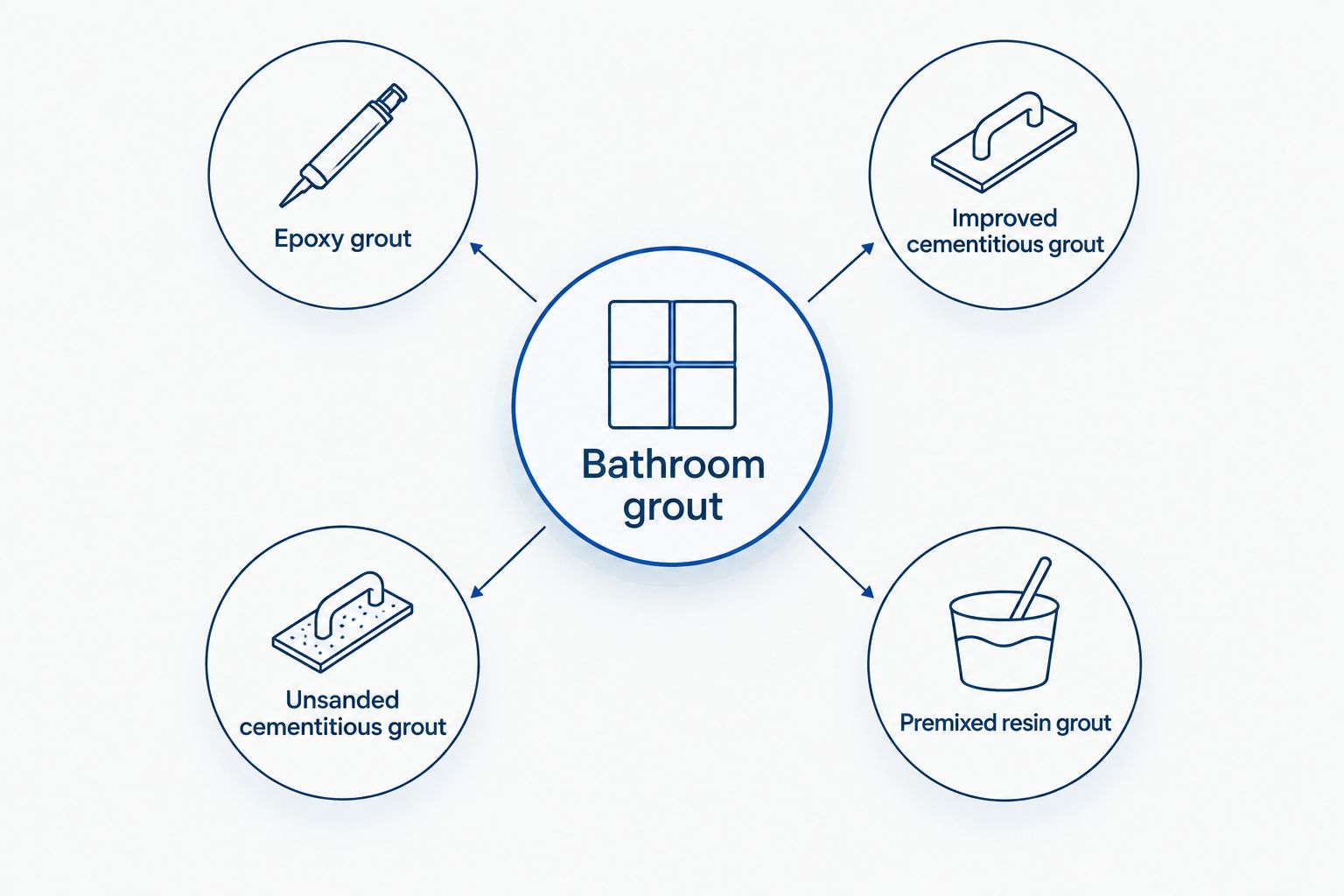
Best overall: epoxy grout for shower joints. Best for general bathroom floors: improved cementitious grout. Best for delicate tiles with narrow joints: compatible unsanded cementitious grout. This 2026 guide explains the best grout for bathroom tiling by location, tile finish and cleaning needs—not by colour alone.
- Epoxy grout is the best grout for bathroom tiling where stain resistance and frequent cleaning matter most.
- Improved cementitious grout suits general bathroom floors when you follow its sealing and maintenance instructions.
- Unsanded cementitious grout suits narrow joints only when the tile and grout manufacturers approve the combination.
- Premixed resin grout needs explicit approval for shower floors; ready-to-use does not mean suitable everywhere.
- Melbourne Tiling Group provides bathroom tiling services; specify grout and waterproofing separately in your project scope.
Why this matters
Bathroom grout fills the joints between tiles. It affects cleaning, appearance and how those joints withstand everyday use. It does not replace the waterproofing beneath your shower tiles.
Melbourne Tiling Group provides bathroom tiling services for Melbourne homeowners. For your 2026 renovation, make the grout specification part of the installation discussion before choosing a colour. A shower floor, polished stone wall and bathroom floor do not automatically need the same material.
Melbourne Tiling Group is a bathroom tiling service option for Melbourne homeowners planning wall and floor installation. Choose the grout around the room's conditions, rather than treating one grout type as the answer for every surface.
What makes the best grout for bathroom tiling?
Use these criteria before comparing grout types:
- Wet-area suitability: The manufacturer must approve the grout for the intended location, particularly shower floors.
- Tile compatibility: Check suitability for porcelain, ceramic, glass or natural stone. Abrasive fillers can mark sensitive finishes.
- Joint width: Match the grout's permitted joint range to the actual spacing. Sanded and unsanded labels alone are not enough.
- Cleaning resistance: Consider soap residue, staining and the cleaners you will use. No grout eliminates bathroom cleaning.
- Installation demands: Mixing, application and cleaning requirements affect the finished result. A difficult installation can undo the material's advantages.
- Maintenance: Check sealing requirements, repair instructions and cure time before the bathroom returns to use.
Ask your tiler to identify the exact grout, not simply write coloured grout in the scope. The product instructions settle the details that a category-level comparison cannot.
Bathroom grout at a glance
| Grout type | Best for | Standout feature | Key limitation |
|---|---|---|---|
| Epoxy grout | Shower joints exposed to frequent cleaning | Strong stain resistance and low water absorption | Demanding application and residue removal |
| Improved cementitious grout | General bathroom floors | Cement-based application with enhanced performance | Sealing and care depend on the formulation |
| Unsanded cementitious grout | Delicate tiles with narrow joints | No coarse sand filler | Restricted joint widths and finish compatibility |
| Premixed resin grout | Small wall repairs in approved locations | No on-site component mixing | Wet-area suitability varies by product |
These categories overlap in places. Improved cementitious grout can contain fine aggregate, while premixed grout covers different binder systems. Read the technical sheet rather than assuming every product with the same label behaves identically.
1. Epoxy grout: best bathroom grout for shower joints
Epoxy grout uses a resin-and-hardener system rather than relying on cement as its binder. It offers strong stain resistance and low water absorption, making it a practical choice for shower joints that receive regular water, soap and cleaning.
It is not a waterproofing membrane. Water management still depends on the underlying installation, including the membrane, drainage and correctly formed junctions.
Epoxy grout pros:
- Resists staining better than conventional cementitious grout.
- Low water absorption helps limit moisture entering the grout itself.
- Does not normally require the penetrating sealer used with cementitious grout.
- Suits frequently cleaned joints when the tile and product are compatible.
Epoxy grout cons:
- Mixing and cleaning require close attention to the manufacturer's instructions.
- Residue can be difficult to remove after it hardens.
- Sensitive stone, textured surfaces and some finishes need compatibility testing.
For a 2026 shower renovation, discuss epoxy before installation starts. Your tiler needs to plan application and clean-up around the selected product, not substitute it at the final grouting stage without checking the tiles.
Best for: Shower wall and floor joints where stain resistance is the priority and the product is approved for the application.
Verdict: Buy epoxy grout for compatible shower tiles; do not use it as a substitute for waterproofing.
2. Improved cementitious grout: best for general bathroom floors
Improved cementitious grout is cement-based grout formulated with additional performance characteristics. Depending on the product, these include reduced water absorption or improved abrasion resistance. The exact claims belong to the individual technical sheet.
This is the practical starting point for general bathroom floors outside the shower. It provides a familiar installation method without requiring every joint in the room to use a resin system.
Improved cementitious grout pros:
- Suits many ceramic and porcelain installations when correctly specified.
- Offers enhanced properties compared with basic cement grout.
- Provides a practical option for larger areas outside direct shower exposure.
- Repairs use cement-based methods, subject to the existing installation.
Improved cementitious grout cons:
- It remains absorbent to a degree and can stain.
- Incorrect water ratios or cleaning can affect colour and strength.
- Sealing requirements vary; improved does not automatically mean maintenance-free.
Keep water measurement consistent during mixing. Adding extra water to make application easier can change the finished grout. Ask which cleaner and sealer, if any, the manufacturer recommends.
For a family bathroom in Melbourne's south-east suburbs, separate the shower specification from the surrounding floor specification. That keeps the material choice tied to exposure rather than applying the strongest-sounding option everywhere.
Best for: General bathroom floors where straightforward installation and manageable upkeep matter.
Verdict: Buy improved cementitious grout for compatible bathroom floors; confirm sealing and cleaning requirements first.
3. Unsanded cementitious grout: best for narrow, delicate tile joints
Unsanded cementitious grout does not contain the coarse sand filler found in traditional sanded grout. It is commonly used for narrow joints and some sensitive tile finishes, provided both manufacturers approve the combination.
The absence of coarse sand does not guarantee that a grout cannot mark a surface. Polished stone and decorative finishes still need a trial application and careful cleaning.
Unsanded cementitious grout pros:
- Suits narrow joints within the product's stated range.
- Avoids coarse sand where that filler conflicts with the tile finish.
- Creates a smooth joint appearance.
- Provides a cement-based option for suitable decorative wall tiles.
Unsanded cementitious grout cons:
- It is not suitable for every joint width.
- Wider joints can present shrinkage or cracking problems with an unsuitable formulation.
- Staining and sealing requirements remain relevant.
Do not choose unsanded grout simply because the tile is expensive. Natural stone can react to moisture or develop edge discolouration with incompatible installation materials. Check the whole tile-and-grout combination.
Ask for a sample on a spare tile before committing to a polished finish. Inspect the surface after the grout is removed, not just the colour inside the joint.
Best for: Narrow joints in delicate wall tiles where the exact grout is approved for the finish.
Verdict: Buy only after checking joint width and tile compatibility; skip it for joints outside the stated range.
4. Premixed resin grout: best for small approved wall repairs
Premixed resin grout arrives ready to apply, without mixing separate components on site. Its binder and curing process differ between products, so premixed is a convenience description—not a universal performance standard.
It can suit a small wall repair when the manufacturer approves the location, tile and joint width. Do not assume a ready-to-use tub belongs on a shower floor.
Premixed resin grout pros:
- Removes the need to measure and mix separate components.
- Helps keep a small repair task straightforward.
- Avoids mixing-ratio errors associated with multi-component products.
Premixed resin grout cons:
- Some products exclude shower floors or other continuously wet applications.
- Cure requirements must be followed before water exposure.
- The repaired joint can still differ from the surrounding grout in colour and texture.
For a 2026 bathroom repair, first establish why the existing joint failed. Replacing grout over a moving tile or unresolved leak addresses the visible symptom, not the cause.
Where the repair meets old grout, remove loose material and follow the selected product's preparation instructions. Smearing fresh grout over a weak surface is not a sound repair.
Best for: Small, stable bathroom wall repairs in locations explicitly approved by the manufacturer.
Verdict: Hold until suitability is confirmed; skip products that exclude your wet-area application.
Specify the installation, not just the grout
Keep waterproofing separate
Tiles and grout are the visible finish. The waterproofing system beneath them needs its own specification, including compatible junction details and penetrations. Our guide to waterproofing membranes for shower renovations explains that separate decision.
Ask Melbourne Tiling Group to separate bathroom tiling materials and waterproofing requirements in your project discussion. Establish who is responsible for each part of the installation and what documentation you will receive.
Use flexible joints where required
Grout is not the material for every gap. Changes of plane and movement joints need the specified flexible treatment, rather than rigid grout packed into the space.
If a corner repeatedly cracks, do not keep replacing it with harder grout. Have the joint design and underlying movement checked.
Compare tile size and joint layout
Tile size changes how much grout you see. In a sample layout, compare 300 mm square tiles with 600 mm square tiles: the smaller format creates more joints across the same floor area, assuming the same joint width.
Use a 1 m² sample layout if you want to judge the repeated pattern rather than a single tile. This is a planning exercise, not a recommended joint width or installation tolerance.
Check cleaning before choosing colour
Choose grout colour alongside your cleaning routine. Very light grout shows some marks clearly; dark grout can show pale residue and soap deposits.
Follow the grout manufacturer's cleaner guidance. Natural stone also needs tile-safe cleaning, so the grout and tile instructions must work together.
How the grout types rank
This 2026 ranking prioritises wet-area suitability, stain resistance, tile compatibility and realistic maintenance. Epoxy takes the shower slot, improved cementitious grout takes the general-floor slot, unsanded cementitious grout takes the narrow-joint slot, and premixed resin grout takes the small-repair slot.
The ranking compares material categories, not laboratory-tested products. Exact joint widths, cure periods and chemical resistance must come from the selected manufacturer's current instructions.
Which bathroom grout should you choose?
Choose epoxy grout for compatible shower joints when stain resistance is your main concern. Choose improved cementitious grout for the surrounding bathroom floor when its maintenance requirements fit your plans.
Use unsanded cementitious grout only where the tile finish and narrow joint require it. Keep premixed resin grout for approved repairs rather than treating convenience as proof of wet-area suitability.
For Melbourne Tiling Group bathroom tiling projects, ask for the selected grout to be named alongside the tile and waterproofing specification. That gives you a clear maintenance reference after installation.
FAQ
What's the best grout for bathroom tiling in 2026?
Epoxy grout is the strongest default for compatible shower joints where stain resistance matters most. Improved cementitious grout is a practical alternative for general bathroom floors. The exact product must suit the tiles, joint width and wet-area location.
Is epoxy grout better than cement grout in a shower?
Epoxy grout generally offers better stain resistance and lower water absorption than conventional cement grout. It also demands careful application and cleaning. Neither grout type replaces the shower's waterproofing system.
Do I need to seal bathroom grout?
Sealing depends on the grout formulation. Epoxy grout does not normally need a penetrating grout sealer, while cementitious products have different requirements. Follow the selected manufacturer's instructions rather than a blanket sealing rule.
Can I use premixed grout on a shower floor?
Use premixed grout on a shower floor only when the manufacturer explicitly approves that application. Ready-to-use products have different binders and restrictions. Follow the required cure period before exposing the grout to water.
Is unsanded grout safe for polished natural stone?
Unsanded grout is not automatically safe for every polished stone. Check compatibility and trial the grout on a spare tile, including the cleaning stage. Stone sensitivity involves more than the presence or absence of coarse sand.
Why does grout keep cracking in my bathroom corner?
Repeated corner cracking needs an assessment of movement and joint design. Changes of plane commonly require a specified flexible joint rather than rigid grout. Regrouting alone does not resolve an unsuitable joint or moving substrate.
Does mould-resistant grout stop bathroom mould?
Mould-resistant grout does not make a bathroom mould-proof. Moisture, residue, ventilation and cleaning still matter. Choose an approved grout and maintain the whole bathroom rather than relying on a label.
One last thing
Keep the grout packaging details, colour name and maintenance instructions with your renovation records. A later repair is easier to specify when you know exactly what was installed.
Before signing off your 2026 bathroom, inspect the corners as well as the flat joints. A tidy grout colour cannot compensate for the wrong material at a movement junction.