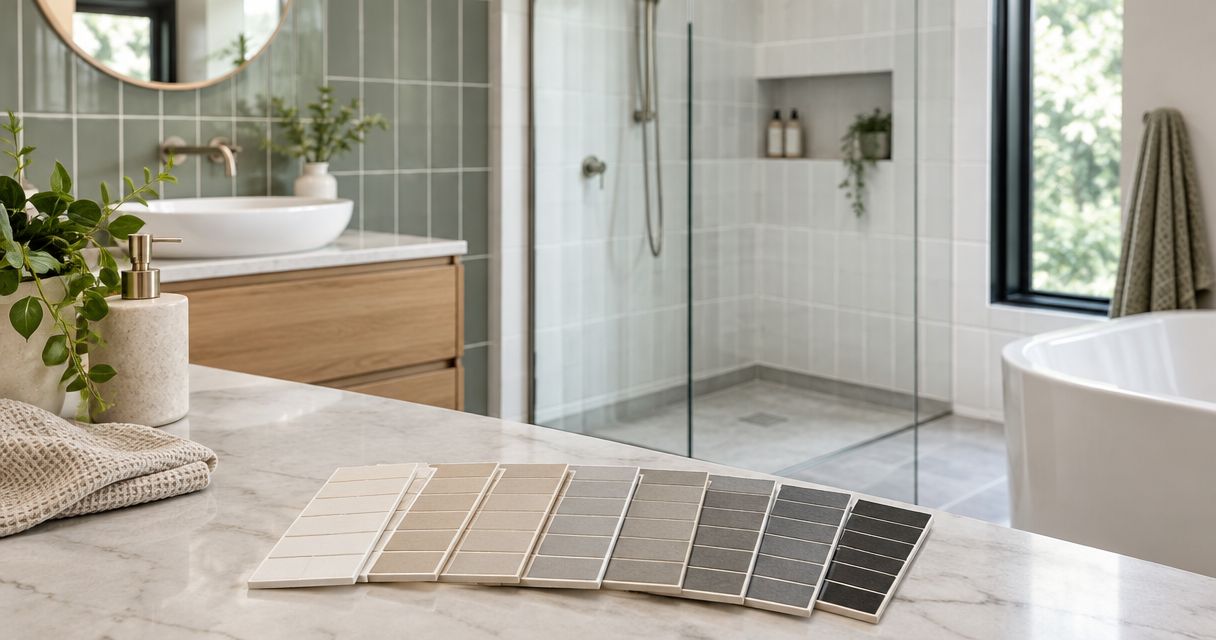
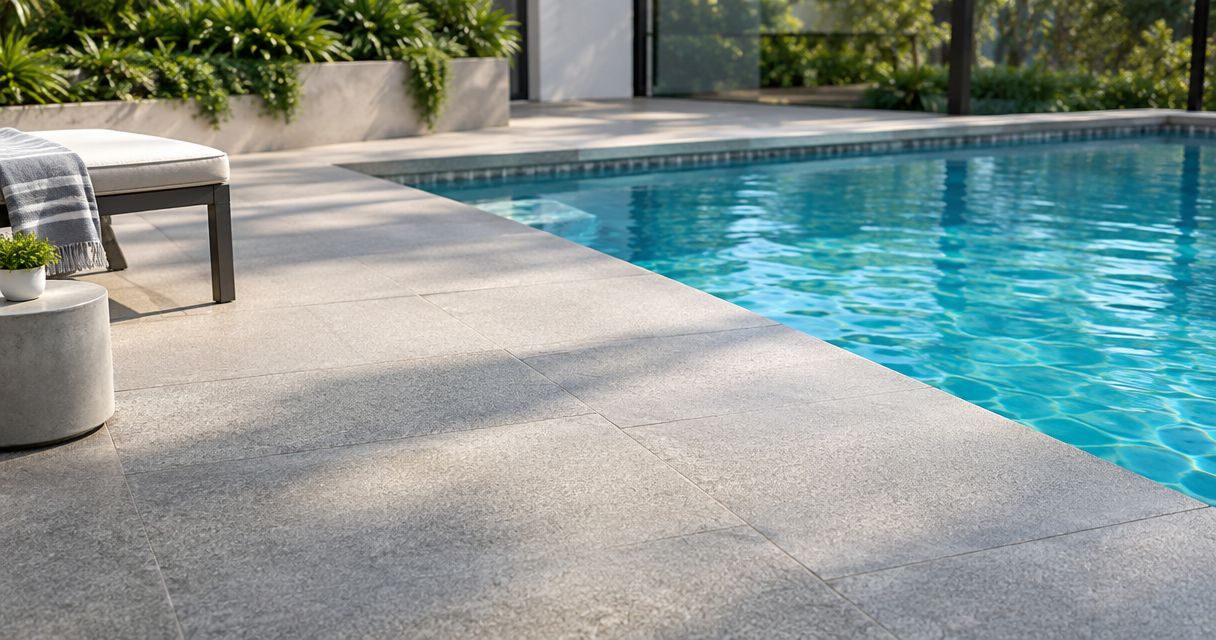
Best overall: textured porcelain with documented wet-barefoot performance. Best for straightforward paving layouts: textured concrete. Best for a natural stone finish with fewer open pores: textured granite. The best slip-resistant pavers for pool surrounds depend on the exact surface finish, drainage and barefoot comfort—not the material name alone.
- The best slip-resistant pavers for pool surrounds start with tested textured porcelain, not smooth outdoor tiles.
- Textured concrete suits straightforward layouts; textured granite suits homeowners who prefer a crystalline natural stone finish.
- Travertine and sandstone need careful checks for surface variation, sealing and pool-water exposure.
- Melbourne Tiling Group provides residential and commercial wall and floor tiling services across Melbourne.
Why this matters
A pool surround gets wet while people walk on it barefoot. A finish that feels secure in shoes does not automatically provide the same grip under bare feet, especially with sunscreen, dirt or algae on the surface.
For your 2026 Melbourne project, choose the paving and installation method together. Water sitting on an otherwise suitable surface is still a problem. So are loose pavers, uneven joints and sharp coping edges.
Melbourne Tiling Group provides wall and floor tiling for homeowners and construction companies. Bring your paving samples, pool-edge details and drainage questions into the planning discussion before committing to materials.
What makes the best slip-resistant pool pavers?
Use these criteria before comparing colours:
- Documented wet grip: Ask for a slip-test report for the exact product and finish, not a different tile from the same range.
- Barefoot comfort: Strong texture needs to feel comfortable where people stand, sit and climb out of the pool.
- Drainage: The paving layout must direct surface water towards the intended drainage points without creating trip edges.
- Exposure suitability: Confirm that the product, grout, bedding and any sealer suit outdoor use and the pool-water treatment system.
- Maintenance: Check how you will remove dirt, sunscreen residue and biological growth without damaging the surface.
- Complete installation scope: Compare base preparation, coping, joints, drainage and sealing—not just the paving material.
Understand the slip-test wording
Australian Standard AS 4586 distinguishes between slip-test methods. Wet pendulum classifications and wet-barefoot ramp classifications describe different tests; an R rating is not a substitute for a wet-barefoot result.
For the wet-barefoot ramp test, the classification thresholds are 12 degrees for Class A, 18 degrees for Class B and 24 degrees for Class C. These are laboratory classification angles, not recommended paving slopes. A higher class does not tell you whether a rough surface will feel comfortable underfoot.
For a 2026 specification, ask the supplier to identify the test method, exact finish and intended application. Have the installer or designer confirm the appropriate classification for your particular pool surround, steps and access points.
Pool paving options at a glance
These are material-and-finish recommendations, not endorsements of every product within each category. Only shortlist a specific paver once its documentation supports your intended use.
| Option | Best for | Standout feature | Key limitation |
|---|---|---|---|
| Textured porcelain | A consistent finish with low water absorption | Manufactured surface and repeatable appearance | Smooth variants are unsuitable substitutes |
| Textured concrete | Straightforward modular paving layouts | Choice of moulded or exposed surface textures | Rough aggregate can irritate bare feet |
| Textured granite | A crystalline natural stone appearance | Dense stone with textured finish options | Polished granite does not offer the same surface grip |
| Tumbled travertine | A softer-looking natural stone setting | Rounded edges and visible natural variation | Open pores and acidic-cleaner sensitivity need attention |
| Textured sandstone | A layered, natural garden appearance | Distinctive grain and surface variation | Stone quality, absorption and texture vary |
1. Textured porcelain: best pool pavers for a consistent finish
Textured outdoor porcelain is the default shortlist when you want a consistent appearance and low water absorption. Choose a product specifically documented for the proposed poolside application; an outdoor label alone is not enough.
The main decision is the surface, not the colour. A stone-look porcelain paver can resemble natural stone without sharing its pores, but the texture still needs to balance wet grip with cleaning and barefoot comfort.
Textured porcelain pros:
- Low water absorption helps distinguish porcelain from more porous paving materials.
- Manufactured formats support a repeatable layout around coping and drains.
- Different textures let you compare grip and comfort within the category.
Textured porcelain cons:
- Heavily textured surfaces can retain dirt and need more thorough cleaning.
- Porcelain requires suitable cutting equipment and an installation system matched to the product.
- A matching smooth tile is not a safe substitute for the specified textured finish.
For a 2026 renovation in Melbourne's south-east, take the sample outside rather than judging it under showroom lighting. Compare it beside your coping and check the supplier's cleaning instructions before choosing the finish.
Best for: Homeowners prioritising a consistent finish and low water absorption.
Verdict: Buy only when the exact textured porcelain product has suitable test documentation.
2. Textured concrete: best pool pavers for straightforward layouts
Textured concrete pavers suit modular pool surrounds where the layout, edging and base preparation are central to the job. Available finishes include moulded textures and exposed aggregate, but these surfaces do not feel the same underfoot.
Choose the texture deliberately. A coarse aggregate finish needs a barefoot comfort check, while a finer-looking surface still needs evidence of wet slip performance.
Textured concrete pros:
- Modular pavers support clearly planned paving and border layouts.
- Surface options let you compare different levels of texture.
- Individually laid units can be lifted for repairs when the installation method allows it.
Textured concrete cons:
- Exposed aggregate can feel harsh where people kneel or sit beside the pool.
- Concrete is porous, so staining and sealer suitability require attention.
- A poorly prepared base can lead to movement and uneven edges.
Do not assume concrete delivers the best value from the material alone. Compare quotes with the same excavation, base, drainage and edging scope. Leaving those items out makes the comparison misleading.
Ask whether sealing is proposed and whether the finished, sealed surface remains suitable for wet barefoot use. Treat the sealer as part of the paving specification.
Best for: Homeowners planning a straightforward modular layout with clearly defined borders.
Verdict: Buy a documented textured finish; skip aggregate that feels abrasive under bare feet.
3. Textured granite: best pool pavers for a dense stone finish
Textured granite suits homeowners who want natural stone without the open holes associated with unfilled travertine. Its crystalline appearance gives the paving a different character from layered sandstone or manufactured porcelain.
The finish determines the shortlist. Flamed and other textured finishes need their own test results; the word granite does not establish slip resistance. Polished granite belongs outside this recommendation.
Textured granite pros:
- Dense stone offers an alternative to visibly open-pored materials.
- Crystalline grain provides a distinct natural appearance.
- Textured finishes allow you to compare different surface treatments.
Textured granite cons:
- Strong texture can be uncomfortable for bare feet and sitting areas.
- Cutting, handling and edge finishing need suitable equipment.
- Colour and surface treatment affect the experience more than a small showroom sample suggests.
Compare samples from the actual proposed supply. Natural variation is part of stone, but you still need agreement on acceptable appearance, coping edges and joint layout.
For your 2026 shortlist, check the stone supplier's guidance on cleaning, pool-water exposure and any proposed sealer. Do not treat a general natural-stone brochure as approval for the selected granite.
Best for: Homeowners who prefer a dense, crystalline natural stone appearance.
Verdict: Buy tested textured granite; skip polished finishes around the wet pool edge.
4. Tumbled travertine: best pool pavers for a softer stone appearance
Tumbled travertine suits a natural stone setting where rounded edges and visible variation are part of the design. Filled and unfilled products need different checks because open holes, fillers and finishing treatments change the surface.
A tumbled label does not establish wet grip. Check the exact product, then look closely at the surface where bare feet, chair legs and cleaning brushes will meet it.
Tumbled travertine pros:
- Rounded edges provide a softer visual finish than sharp-edged paving.
- Natural variation suits gardens that do not need a uniform appearance.
- Different filling and finishing options allow a deliberate surface choice.
Tumbled travertine cons:
- Open pores can collect dirt and complicate cleaning.
- Travertine is sensitive to acidic cleaners.
- Fillers, sealers and stone quality need confirmation for the proposed exposure.
Ask how visible holes will be handled, including those revealed during cutting. Check that the coping finish and field paving work together rather than assuming matching colour means matching performance.
Choose travertine because you accept its maintenance requirements, not because a sample looks attractive when dry. Keep the approved cleaning method with your handover information.
Best for: Homeowners who want rounded-edge natural stone and accept more involved surface care.
Verdict: Hold until the finish, filling, sealing and wet-grip details are confirmed.
5. Textured sandstone: best pool pavers for a garden-led appearance
Textured sandstone suits a pool surround designed to connect visually with a natural garden. Its grain, layering and colour variation distinguish it from granite and porcelain.
Sandstone is not one uniform material. Different stones vary in absorption, strength and surface behaviour, so the selected supply needs more than a generic sandstone description.
Textured sandstone pros:
- Layered grain creates a recognisable natural stone appearance.
- Surface variation suits informal garden designs.
- Different finishes provide options beyond a smooth sawn surface.
Textured sandstone cons:
- Absorption and durability vary between stones.
- Uneven texture can make furniture placement and barefoot walking less comfortable.
- Cleaning and sealing need to match the exact stone.
Ask for documented suitability for outdoor pool surrounds and the pool's treatment system. Examine surface consistency across several samples, including edge pieces, rather than approving one attractive piece.
Check how the proposed installation will handle uneven thickness and surface variation. Good-looking stone does not compensate for a poorly planned base or water collecting between pavers.
Best for: Homeowners prioritising a layered stone appearance alongside garden planting.
Verdict: Hold until the selected sandstone's suitability and surface consistency are documented.
Plan the installation before ordering
A slip-resistant finish is only one part of a usable pool surround. Melbourne Tiling Group provides residential and commercial wall and floor tiling; discuss the intended paving system and project scope before assuming a material suits the job.
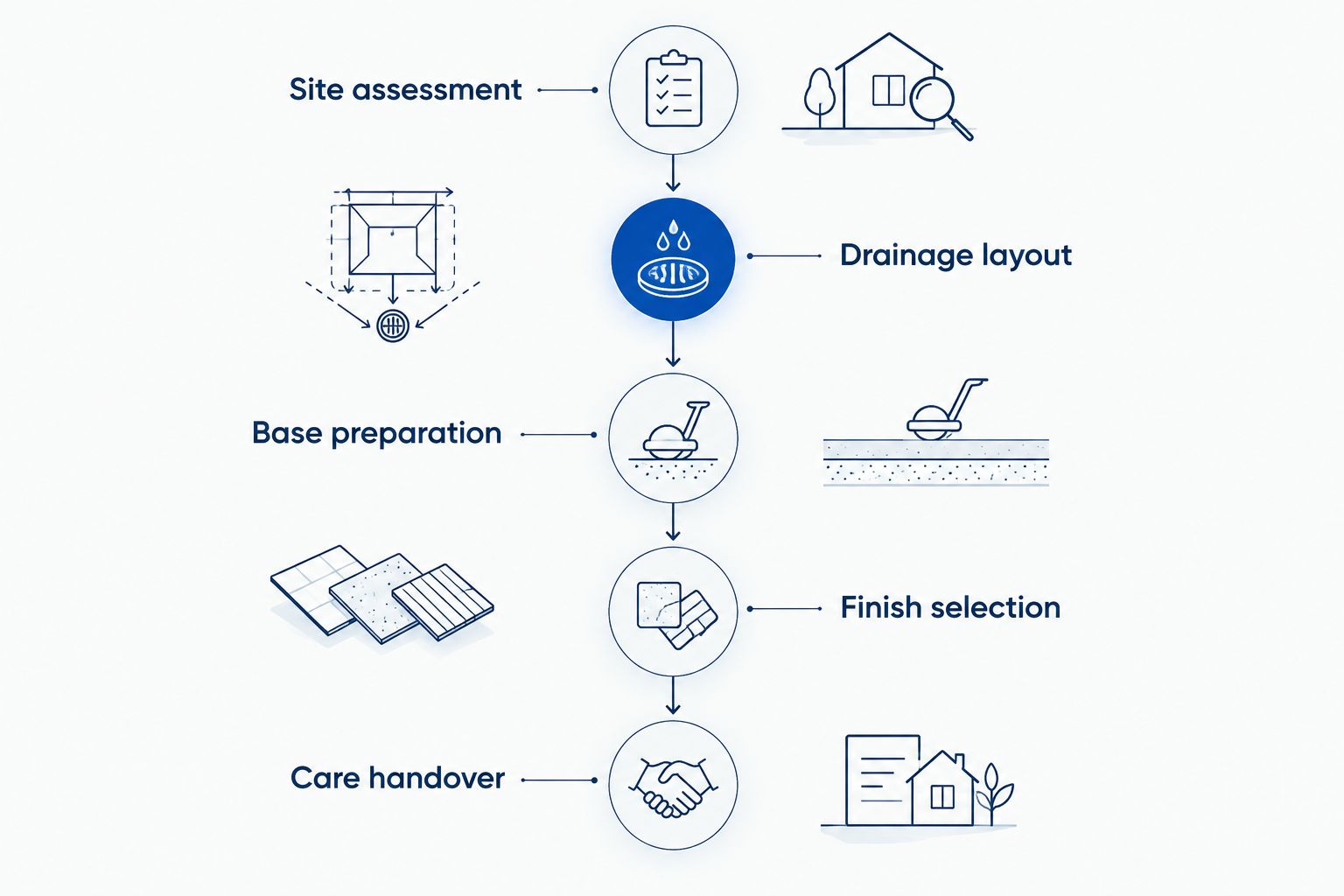
Use this sequence for your 2026 planning:
- Site assessment: Record the existing levels, access, pool edge and adjoining surfaces.
- Drainage layout: Decide where surface water should go and how drains meet the paving.
- Base preparation: Specify a stable base and a laying method suited to the chosen paver.
- Finish selection: Confirm the exact product, slip documentation, coping and joint treatment.
- Care handover: Keep cleaning instructions and any sealing requirements with the project records.
The decisions depend on each other. Changing paver thickness after the levels are set can affect the coping, adjoining paths and drainage details.
Waterproofing also needs a clear scope wherever the project includes areas that require it. Pavers, grout and sealers are not substitutes for a specified waterproofing system. Ask who is responsible for each detail before work starts.
How the options are ranked
Textured porcelain takes the default position because consistent manufacture and low water absorption simplify material selection. Concrete serves straightforward modular layouts. Granite, travertine and sandstone each occupy a distinct natural stone slot.
This is a material-selection guide, not a laboratory ranking of named products. Every recommendation remains dependent on the exact finish, documented suitability and installation details.
Which pool pavers should you choose?
Start with tested textured porcelain if you do not have a strong natural stone preference. Compare barefoot comfort, cleaning requirements and the complete installation scope before choosing between samples.
Choose textured concrete for a modular layout, granite for crystalline stone, travertine for rounded-edge character or sandstone for a layered garden appearance. Do not approve any option solely because it is described as non-slip.
FAQ
What's the best slip-resistant paving for a Melbourne pool surround?
Textured porcelain with suitable wet-barefoot test documentation is the default shortlist. The exact finish, drainage and barefoot comfort matter more than the porcelain label alone.
Are porcelain pavers better than travertine around a pool?
Porcelain suits homeowners prioritising low water absorption and a consistent finish; travertine suits those who prefer natural variation and rounded edges. Travertine needs closer attention to pores, fillers, cleaning and sealing.
Does an R rating prove a paver is safe around a pool?
An R rating alone does not establish wet-barefoot suitability. Ask which test method was used and have the appropriate classification confirmed for the pool surround and access points.
Can sealing make pool pavers slippery?
A sealer can change the surface's slip performance. Confirm that the exact sealer and application suit the paver, and check evidence for the finished surface rather than relying only on the unsealed product's result.
Should I choose rougher pavers for better grip?
Choose documented wet grip rather than roughness alone. An aggressive texture can be uncomfortable for bare feet and harder to clean, so compare both performance evidence and a physical sample.
How do I compare pool paving quotes without choosing on price alone?
Compare the same installation scope, including excavation, base preparation, drainage, coping, joints and any sealing. Ask each contractor to identify exclusions so you can judge value without overlooking necessary work.
Does Melbourne Tiling Group provide tiling services for homeowners?
Melbourne Tiling Group provides residential and commercial wall and floor tiling for Melbourne homeowners and construction companies. Discuss your proposed outdoor paving work directly to confirm the project scope.
One last thing
Keep one approved sample with the product identification and finish details. It gives you a reference when the delivery arrives and when future maintenance decisions arise.
The most useful final check is simple: make sure the delivered finish is the finish named in the test documentation. A similar colour is not the same specification.