Best overall: aluminium tile trim. Best for exposed, hard-wearing corners: stainless steel. Best for simple wall-edge finishing: PVC. The best tile trims for bathrooms in 2026 match your tile thickness, protect exposed edges and suit the room’s fittings; this guide compares those options with ceramic bullnose tiles and mitred edges.
- Aluminium is the best tile trim for bathrooms needing a neat, practical finish.
- Stainless steel suits exposed corners; ceramic bullnose suits bathrooms with matching tile ranges.
- Bathroom waterproofing belongs beneath the tiles; decorative edging does not replace it.
- Melbourne Tiling Group suits homeowners seeking bathroom tiling installation.
For installation rather than a trim-only purchase, Melbourne Tiling Group provides residential wall and floor tiling, including bathrooms. Decide on the edge detail before tiles go on the wall, not when the tiler reaches the final row.
Why bathroom edging matters
A bathroom trim covers an exposed tile edge and gives corners a deliberate finish. It also protects vulnerable edges from contact. The wrong profile leaves an awkward lip, an exposed cut or a narrow channel that is difficult to clean.
For a Melbourne bathroom renovation in 2026, choose trims alongside the tiles, tapware and shower screen. That applies whether you are updating a south-east suburban ensuite or planning a larger family bathroom. Tile size alone does not tell you which edging will fit.
Trim is a finishing detail, not a waterproofing system. Water protection depends on the wet-area construction beneath the surface. A tidy metal edge cannot correct a poorly prepared shower junction.
What makes the best tile trims for bathrooms?
Use these criteria before choosing a material or colour:
- Profile fit: Match the trim opening to the actual tile and the manufacturer’s installation detail. Do not select by appearance alone.
- Edge protection: Give exposed external corners more protection than sheltered wall terminations.
- Wet-area suitability: Check that the specific trim, coating and fixing method suit the intended bathroom location.
- Cleaning requirements: Choose a surface you can maintain with the cleaning products approved for that finish.
- Visual consistency: Coordinate the profile with tapware, shower framing and tile joints. Similar colour names do not guarantee matching finishes.
- Junction detail: Plan where trims meet, terminate or change direction, including niches, windows and shower entrances.
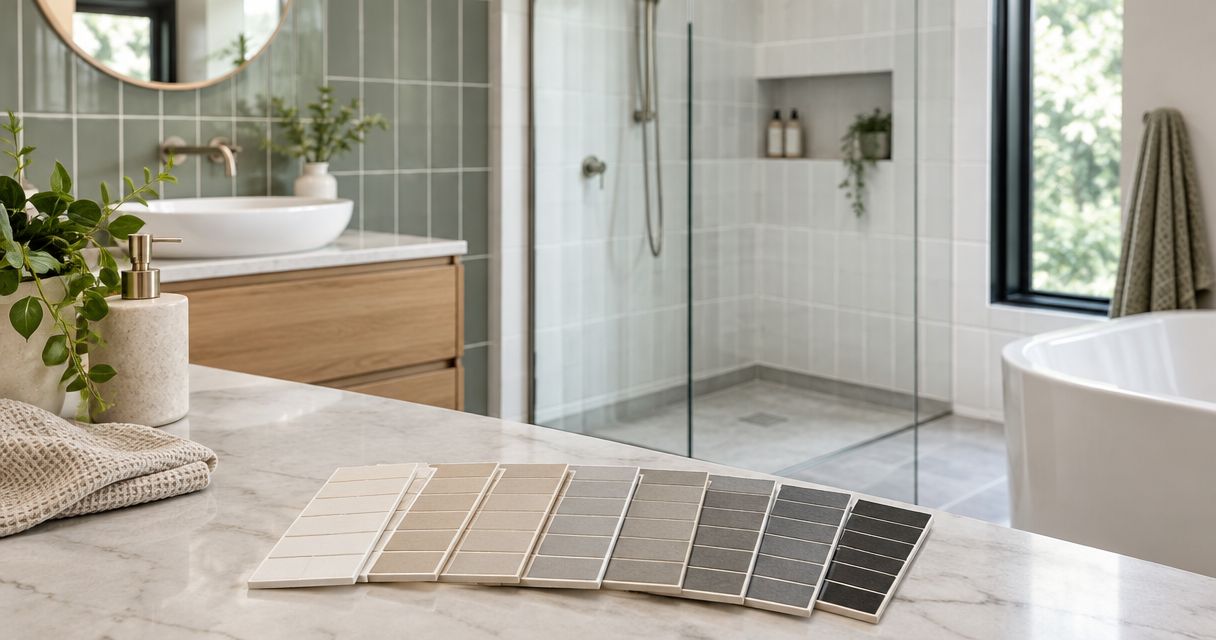
Compare 2 physical samples beside your tile: the preferred finish and its closest alternative. View both in the bathroom lighting. A polished edge and a brushed edge reflect light differently, even when both are described as silver.
Bathroom tile edging at a glance
| Option | Best for | Standout feature | Key limitation |
|---|---|---|---|
| Aluminium tile trim | General bathroom wall edges | Defined edge with different profile and finish choices | Exposed coatings can scratch; cleaner compatibility matters |
| Stainless steel tile trim | Corners exposed to knocks | Hard-wearing metal edge | Grade and surface finish need checking for the location |
| PVC tile trim | Simple painted-wall transitions | Straightforward non-metal edging | Softer surface is less suited to exposed, high-contact corners |
| Ceramic bullnose tiles | Bathrooms with matching traditional edging | Rounded, finished ceramic edge | Depends on a suitable matching tile range |
| Mitred tile edges | Trim-free niches and feature corners | Tile faces meet without a separate visible strip | Thin cut edges are vulnerable to chipping |
These are edging approaches, not interchangeable products. A wall termination, an external shower corner and a bathroom doorway each need their own detail. Do not force one decorative profile to handle every junction.
1. Aluminium tile trim: best for general bathroom wall edges
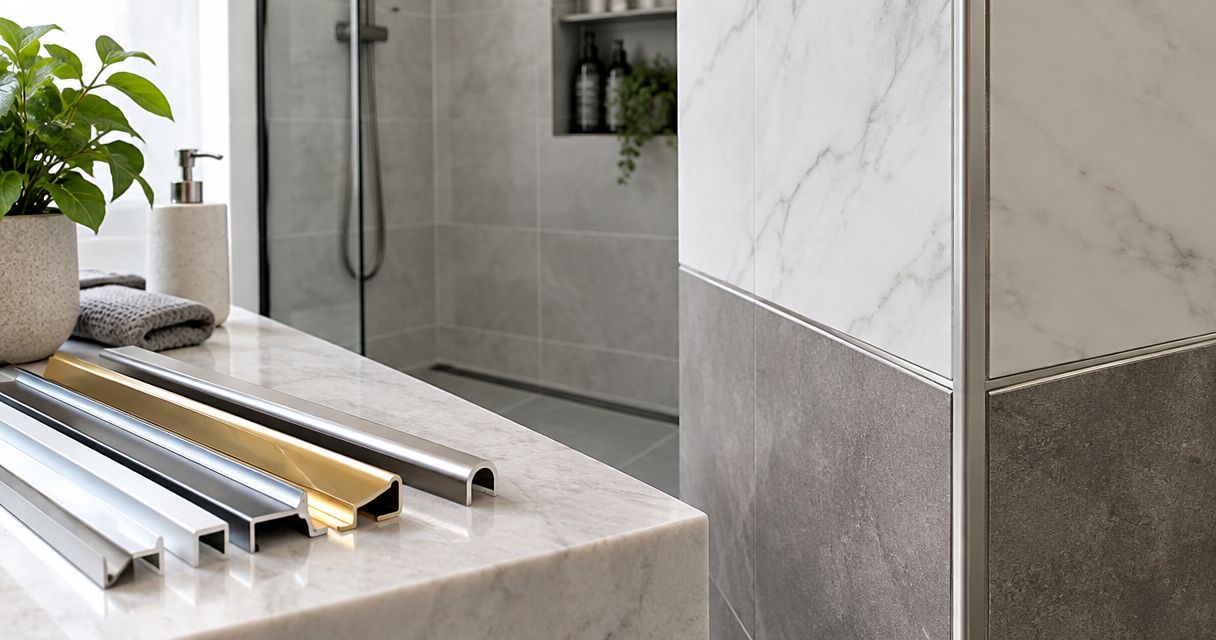
Aluminium tile trim creates a defined edge where tiles stop or turn an external corner. Common profile shapes include square and rounded edges. Choose the shape that suits the tile layout, then check the individual product’s suitability for the intended wet-area position.
For most straightforward bathroom wall finishes, aluminium is the practical starting point. It provides a separate protective edge without requiring matching ceramic finishing tiles. The visible strip still becomes part of the design, so judge it against the whole room rather than the tapware alone.
Aluminium tile trim pros:
- Gives cut tile edges a deliberate finish.
- Offers different profile shapes and surface finishes.
- Works as a consistent detail across wall ends and external corners.
Aluminium tile trim cons:
- Scratches or damaged coatings can remain visible.
- Unsuitable cleaners can damage the finish.
- Poorly cut intersections make the metal detail look untidy.
Best for: General bathroom wall edges where you want a neat, visible frame.
Ask your tiler to show how the trim will finish at the top and bottom of the wall. A good long edge still looks unfinished if its ends are poorly resolved. Check the manufacturer’s care instructions before choosing cleaning products.
Verdict: Buy aluminium trim as the default, after checking profile fit and wet-area suitability.
2. Stainless steel tile trim: best for exposed corners
Stainless steel tile trim suits exposed edges that need a hard-wearing finish. Its surface is metal rather than a decorative colour coating, although the exact appearance depends on the product. Brushed and polished finishes produce noticeably different results.
Choose stainless steel because the corner needs protection, not because the name sounds more durable. The grade, construction and approved cleaning method still matter. Bathroom conditions do not make every stainless steel profile interchangeable.
Stainless steel tile trim pros:
- Provides a hard-wearing edge at exposed external corners.
- Suits bathrooms with visible metal fittings.
- Offers a distinct brushed or polished finish without relying on a coloured coating.
Stainless steel tile trim cons:
- Polished surfaces show fingerprints and water marks.
- Cutting and joining need suitable tools and careful finishing.
- The wrong grade or unsuitable chemical exposure can cause corrosion.
Best for: External corners beside frequently used bathroom openings or other contact-prone edges.
Inspect the cut ends and corner joints before handover. They should be neatly finished, with no sharp burrs left exposed. A strong material does not excuse a rough installation, particularly near towels, hands and bare skin.
Verdict: Buy stainless steel for exposed corners when the specified grade suits the location.
3. PVC tile trim: best for simple painted-wall transitions
PVC tile trim covers the tile edge with a non-metal profile. It suits straightforward wall terminations where the finish does not need to match metal fittings. A white profile can create a quiet transition between pale tiles and a painted wall.
Keep PVC away from the decision simply to make every edge identical. A sheltered wall end and an exposed shower entrance face different demands. Select the material for the position, then confirm that its colour and shape work with the tile.
PVC tile trim pros:
- Provides a simple finish at tiled-to-painted wall transitions.
- Avoids a metallic strip where that would interrupt the design.
- Can coordinate with pale ceramic tiles and painted surfaces.
PVC tile trim cons:
- The softer surface is more vulnerable to scratches and knocks.
- Colour differences stand out beside mismatched whites.
- A prominent plastic edge does not suit every bathroom finish.
Best for: Sheltered wall terminations where a plain, non-metal edge is the priority.
Hold the sample against both the tile face and the painted surface. Do not assume that a white trim will disappear beside a white tile. Check its shape too: a rounded profile creates a different line from a square-edged finish.
Verdict: Buy PVC for simple sheltered edges; skip it for corners needing stronger impact protection.
4. Ceramic bullnose tiles: best for matching traditional finishes
A ceramic bullnose tile has a rounded, finished edge that replaces a separate trim at the wall termination. It belongs to the tile layout rather than forming a contrasting metal or plastic strip. This makes it useful where the bathroom design calls for a continuous ceramic finish.
The deciding factor is the tile range. A matching field tile and bullnose tile need compatible dimensions, colour and surface finish. An almost-matching ceramic edge can be more distracting than an intentional contrast.
Ceramic bullnose tile pros:
- Gives the wall a finished ceramic edge.
- Creates a rounded termination without a separate metal strip.
- Suits traditional layouts when matching pieces are part of the chosen range.
Ceramic bullnose tile cons:
- Not every tile range includes matching edging pieces.
- Dimensions can restrict the layout at niches and corners.
- Colour or glaze differences become obvious at the wall boundary.
Best for: Traditional bathrooms planned around a tile range with compatible finishing pieces.
Confirm the edging pieces before committing to the field tiles. Include corners and returns in that check, not just straight wall ends. The layout should show where each finishing piece belongs so the final course does not become a patchwork.
Verdict: Buy ceramic bullnose when the matching range supports the complete layout.
5. Mitred tile edges: best for trim-free feature corners
A mitred edge is a cut in the tile, not a separate trim. The adjoining edges are bevelled so the tile faces meet around a corner. This creates a continuous tile finish without a visible metal or plastic border.
Mitres suit feature details where the tile itself should dominate, such as a niche surround. They demand careful cutting and alignment. The thin edge left by the cut also needs protection during installation and everyday use.
Mitred tile edge pros:
- Removes the separate decorative strip from the corner.
- Keeps the tile colour and pattern central to the finish.
- Creates a consistent approach for selected feature returns.
Mitred tile edge cons:
- Thin cut edges are vulnerable to chips.
- Uneven cutting or alignment is difficult to disguise.
- Not every tile material or corner position suits the detail.
Best for: Selected niches and feature corners where a trim-free appearance outweighs the need for a protective profile.
Discuss the corner detail with the installer before approving it. Ask how the tile material will be cut and how the finished edge will handle contact. Avoid choosing mitres solely from a photograph that hides the corner close-up.
Verdict: Hold until the tiler confirms the tile and location suit a mitred finish.
Plan the edging before installation
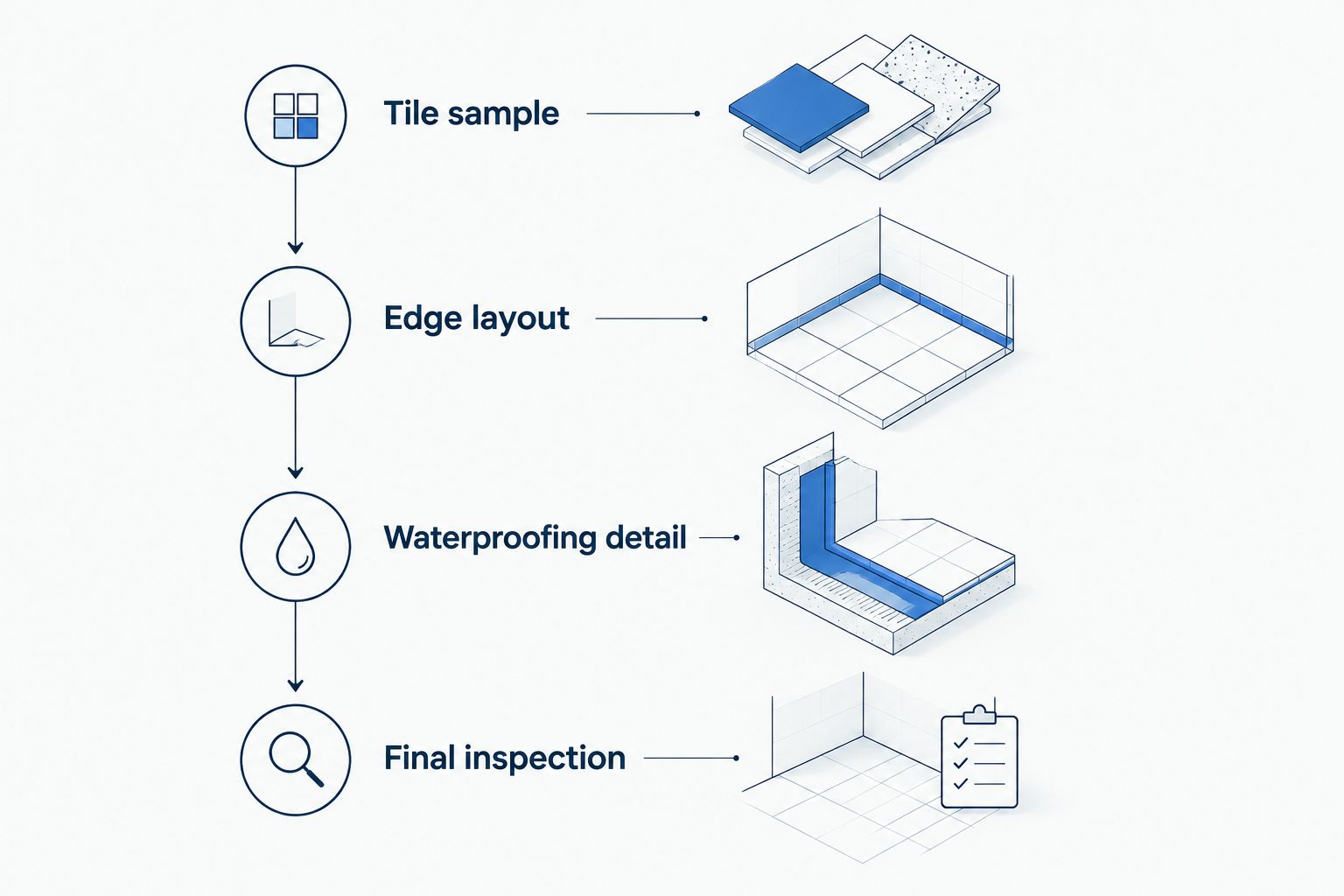
For bathroom tiling in 2026, Melbourne Tiling Group provides installation services for homeowners and construction companies. Bring the tile sample and your preferred edging approach into the installation discussion early. That makes the edge detail part of the layout rather than an afterthought.
Tile sample
Check the actual tile, including its thickness and edge shape. Nominal dimensions are not enough to choose a trim profile. Ask the installer to confirm the fit against the proposed installation detail.
Edge layout
Mark every exposed edge on the bathroom plan. Check 3 junctions particularly carefully: niche corners, tiled-to-painted wall ends and shower-entry edges. Decide where the profile stops and how adjoining pieces meet.
Waterproofing detail
Separate the decorative edge decision from the wet-area construction. Niches, penetrations and changes of plane need their own waterproofing details. Read the guide to waterproofing membranes for shower renovations before treating a finished tile surface as proof of water protection.
Final inspection
At handover, make 4 checks: exposed cut ends, corner alignment, sharp edges and surface damage. Also ask for the trim’s cleaning instructions. Correct care matters for aluminium coatings, stainless steel surfaces and ceramic finishes alike.
How the options are ranked
This 2026 guide ranks edging approaches by profile fit, edge protection, wet-area suitability, cleaning and layout compatibility. It compares material characteristics, not named products or installation test results.
Aluminium leads as the general-purpose option. Stainless steel takes the exposed-corner slot, while PVC suits simpler wall transitions. Ceramic bullnose and mitred edges solve more specific design needs; neither is a universal replacement for protective trim.
Which bathroom tile edging should you choose?
Choose aluminium unless your bathroom has a clear reason for another finish. Move to stainless steel for contact-prone corners, ceramic bullnose for a compatible traditional tile range, or mitres for carefully selected trim-free details. Keep PVC for sheltered edges where its appearance fits.
For your 2026 renovation, settle the profile and junctions before installation begins. A written scope should distinguish tile preparation, waterproofing responsibilities, edging and final finishing. Compare what each quote includes, rather than judging value from the total alone.
Plan your bathroom tiling
Discuss wall and floor tiling, tile choices and edge details for your Melbourne bathroom.
FAQ
What's the best tile trim for a bathroom?
Aluminium is the best general-purpose starting point for bathroom tile trim. Check the particular profile’s fit, finish and wet-area suitability before choosing it.
Is stainless steel tile trim better than aluminium?
Stainless steel is the better choice for exposed corners needing a hard-wearing metal edge. Aluminium remains a practical option for general wall finishing; the specific product and location decide the choice.
Can I use PVC trim inside a bathroom?
PVC trim suits simple bathroom wall edges when the specific product is approved for the intended location. Its softer surface makes it less suitable for exposed corners that receive knocks.
Do bathroom tiles need edging everywhere?
Bathroom tiles need an appropriate finish wherever an edge remains exposed. That finish can be a separate trim, a ceramic finishing tile or a suitable mitred detail; concealed edges do not need decorative trim simply for consistency.
What size tile trim should I choose?
Choose the trim profile against the actual tile sample and the manufacturer’s installation detail. Ask the tiler to confirm the fit rather than selecting from nominal tile thickness alone.
Does tile trim waterproof a shower corner?
Tile trim does not replace shower waterproofing. The membrane, junctions and penetrations beneath the finished surface need a correctly detailed wet-area system.
Are mitred tile edges a good choice for shower niches?
Mitred edges suit shower niches when the tile material and installation detail support them. They remove the visible trim strip, but their thin cut edges are more vulnerable to chips.
Can Melbourne Tiling Group install bathroom tiles?
Melbourne Tiling Group provides residential and commercial bathroom tiling as part of its wall and floor tiling services. Discuss the proposed tiles and edge finishes as part of the installation scope.
One last thing
The smallest exposed cut can draw more attention than a long, straight trim. Before approving your 2026 bathroom layout, ask where the edging ends at eye level: beside the mirror, above the niche and at the shower entrance.
Resolve those terminations first. A simple profile with clean ends is a better finish than an elaborate edging choice with awkward junctions.