
A licensed tiler’s daily charge in Melbourne is a job-specific labour rate, not a fixed citywide fee. For a 2026 quote, check the working hours, number of workers and included tasks before comparing daily charges. Tile removal, surface repairs, waterproofing, materials and rubbish disposal need separate confirmation; a labour day rate does not tell you the full installation cost.
- Compare a licensed tiler day rate Melbourne quote by hours, crew size and written scope, not the daily figure alone.
- For bathroom tiling, confirm preparation and waterproofing responsibilities before installation starts.
- A fixed installation quote gives clearer budget boundaries only when inclusions and variations are written down.
- Melbourne Tiling Group provides residential and commercial wall and floor tiling; request a scope matched to your project.
How much does a licensed tiler charge per day in Melbourne?
Treat the day rate as a labour charge, not a finished-job quote. You need the expected labour time and the separate work items before you can judge the total commitment.
When discussing tiling services, describe the room, existing surface, tile selection and finish you want. A bathroom renovation needs a different scope from a kitchen splashback or an open floor.
Ask the tiler to separate these items in the written estimate:
| Quote item | What to confirm | Why it matters |
|---|---|---|
| Labour day | Working hours and number of workers | A daily charge is unclear without both |
| Preparation | Removal, repairs, levelling and screeding | Installation needs a suitable surface |
| Waterproofing | Included work, responsible contractor and records | Wet-area preparation needs its own scope |
| Installation | Layout, cuts, trims, grout and movement joints | Finishing details affect the work required |
| Materials | Who supplies tiles and installation materials | Labour-only and supply-and-install quotes differ |
| Completion | Cleaning, waste removal and return visits | Finishing work must not fall between trades |
For your 2026 budget, request an estimated labour allowance alongside the daily charge. Keep any provisional work clearly identified rather than treating it as part of a guaranteed total.
Why this matters
A lower daily charge does not automatically mean a lower completed-job cost. Different working hours, crew sizes and exclusions make headline figures poor comparisons.
Bathrooms make this especially clear. Removing old tiles, repairing the base, forming falls and preparing waterproofing are different tasks from laying the new finish. Comparing installation labour alone leaves those responsibilities unresolved.
Compare the same finished result, not just the same unit of time. That gives you a practical basis for choosing a quote and keeps essential preparation visible.
Day rate, hourly rate or fixed quote: which suits your job?
The payment method changes how you manage the budget. It does not replace a clear description of the work.
| Charging method | Best for | Main advantage | Main limitation |
|---|---|---|---|
| Day rate | Work you can supervise with a defined daily scope | Makes the agreed daily labour charge clear | Total labour spending depends on time used |
| Hourly rate | Small tasks with an agreed boundary | Records labour against time worked | Requires clear time records and approval limits |
| Fixed installation quote | A measured job with settled specifications | Sets an agreed amount for the listed work | Exclusions and variations still need attention |
Day rate: agree on what a working day includes
A day rate suits a clearly described package of labour when you accept that the final duration is not fixed. Its weakness is budget uncertainty if preparation or finishing work remains undefined.
Ask whether setup, material collection, cleaning and travel form part of the charged day. Confirm how partial days and return visits are handled rather than assuming the arrangement.
Hourly rate: set a boundary before work starts
An hourly arrangement suits a limited task when the tiler records time and you agree on the work boundary. It becomes harder to manage when a small repair expands into removal or base repairs.
Set an approval point before additional work begins. Ask for an explanation of the changed scope, not simply an updated running total.
Fixed quote: settle the details first
A fixed quote suits a defined installation with agreed surfaces, tiles, layout and finishing details. Its main advantage is a clearer commitment for the listed work; its limitation is that work outside that list still requires agreement.
For a 2026 bathroom renovation, check whether the fixed amount covers preparation and waterproofing or only tile installation. The heading on the quote is less useful than the inclusions beneath it.
Why a tiler’s daily charge and total labour vary
The useful question is not just what a day costs. Ask what the tiler expects to complete and what conditions that estimate assumes.
- Surface condition: Loose material, uneven floors and damaged backing need attention before tiles are installed. Ask which repairs are included and how concealed damage will be handled.
- Tile material and format: Tile dimensions, thickness and material affect cutting, handling and installation requirements. Give the tiler the actual tile details rather than a general description.
- Layout and finishing: Niches, corners, patterned layouts, edges and penetrations add tasks beyond covering an open surface. Show these details before the quote is finalised.
- Wet-area preparation: Shower falls, waterproofing interfaces and preparation stages need coordination. Confirm the work sequence and who takes responsibility for each stage.
- Access and work area: Stairs, restricted access, occupied rooms and material storage affect how the work is organised. Describe the site accurately when requesting the estimate.
- Scope and crew: A labour-only day, a crew day and an installation package describe different commitments. Confirm what the quoted unit actually buys.
These are scope questions, not reasons to accept unexplained extras. Ask for a clear connection between the site condition, the required task and the proposed variation.
How do I compare tiler quotes fairly?
Use the same project brief for every quote. When each tiler receives different information, you end up comparing different jobs.
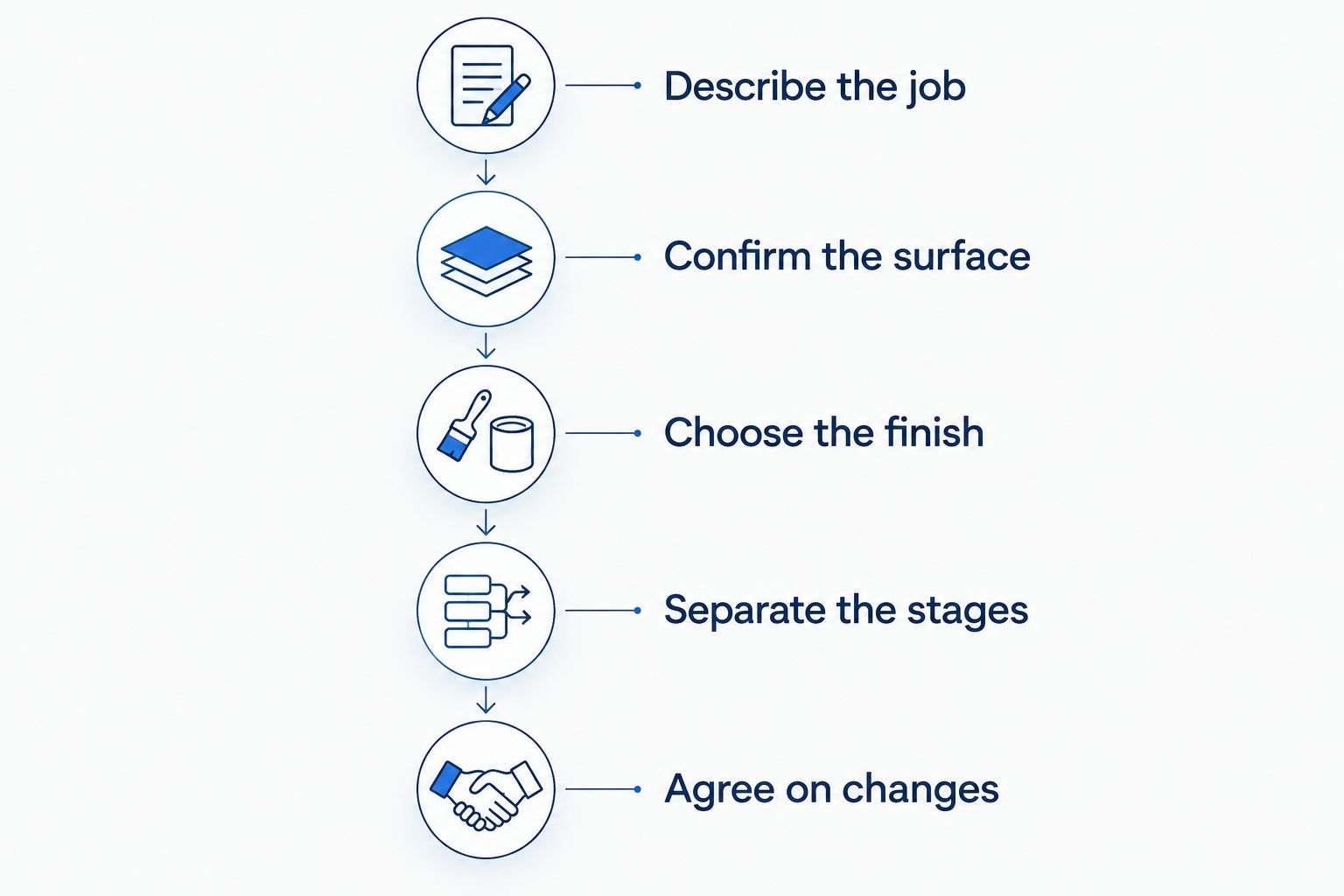
Describe the job
Provide the suburb, room type, approximate tiled area and photographs. Include doorways, corners, drains, cabinetry and any visible damage, not just a close-up of the existing tiles.
For a south-east Melbourne home, explain access and whether the rooms will remain occupied. Give practical information without assuming that a suburb alone explains the work required.
Confirm the surface
State whether the job involves bare concrete, existing tiles, wall lining or a stripped bathroom. Ask the tiler to identify what needs checking on site before the scope is settled.
Do not describe a surface as ready simply because it looks flat. Soundness, cleanliness and suitability for the proposed installation matter too.
Choose the finish
Share the tile specifications, intended pattern, grout choice and edge treatment. Mark feature walls, niches and changes of material on the plan or photographs.
If those choices remain open, ask which assumptions the estimate uses. Changing the layout after work starts changes the agreed task.
Separate the stages
Ask for preparation, waterproofing, installation and completion to be identified separately. This does not require separate contractors; it makes responsibility clear.
The guide to waterproofing sign-off before tile installation helps you plan the handover between those stages. Keep that handover visible in the schedule.
Agree on changes
Record how extra work will be described and approved. Before accepting a variation, ask what changed, what work is required and how it affects completion.
For a 2026 quote comparison, keep the scope, exclusions and proposed sequence together. A scattered collection of messages is harder to check than a single agreed document.
What should a bathroom tiling quote include?
A bathroom quote should identify the surfaces being tiled and the condition expected before installation. It should also distinguish tile work from plumbing, electrical work and other renovation tasks.
Check the removal scope first. Taking off old tiles is not the same as repairing whatever is exposed underneath, so ask how those repairs will be assessed.
Next, confirm the waterproofing responsibility and installation sequence. Tiles and grout are not a substitute for a properly specified wet-area waterproofing system, and a tiling day rate alone does not describe that system.
Finally, check the finish: drain interfaces, corners, trims, grout, movement joints and cleaning. Ask what records and care instructions you will receive at completion.
Protect preparation and waterproofing before spending on decorative details. If you need to simplify the job, discuss the tile layout and feature work rather than removing essential substrate preparation.
Does a small splashback need a different quote?
A kitchen splashback needs a scope that accounts for cuts and finishing, not just the wall area. Power points, cabinet edges, corners and the chosen pattern all belong in the brief.
Confirm that cabinetry and benchtops are ready before arranging installation. Ask who coordinates electrical work where fittings affect the tiled surface; do not leave that responsibility implied.
A small area still involves setup and completion tasks. Ask how the tiler treats a short installation and any separate grouting or finishing visit, rather than assuming it fits neatly into part of a charged day.
What does “licensed tiler” actually tell me?
The phrase alone does not establish the contractor’s credentials or the work they are authorised to undertake. Ask for the relevant registration or licence details and verify them with the issuing authority for your particular project.
Also confirm the contracting business name, insurance details and responsibility for waterproofing. A description in an advertisement is not a substitute for checking the person or business named on your agreement.
For your 2026 renovation, keep credential checks separate from workmanship questions. Ask about the proposed substrate preparation, installation method and wet-area sequence as well as the paperwork.
Is Melbourne Tiling Group relevant to my project?
Melbourne Tiling Group suits homeowners and construction companies seeking residential or commercial wall and floor tiling in Melbourne. Its stated services include bathroom, kitchen and floor tiling.
That service scope makes it relevant when your project involves those installations. It does not establish what your individual quote includes, so confirm preparation, waterproofing responsibility, materials and completion tasks before agreeing to work.
Ask Melbourne Tiling Group for a written scope matched to your room and tile selection. You still need to check credentials and compare inclusions; the business name alone does not answer those questions.
Request a scoped tiling quote
Describe your room, existing surfaces and tile selection so the required work can be discussed.
FAQ
Does a tiler’s day rate include tiles and adhesive?
A tiler’s day rate does not, by itself, establish whether materials are included. Ask the written quote to identify tiles, adhesive, grout, trims and other installation materials separately.
Is a fixed quote better than a day rate for bathroom tiling?
A fixed quote gives clearer budget boundaries for a fully defined bathroom installation. Check its exclusions and variation terms, because preparation or concealed repairs can sit outside the listed work.
Can I compare quotes using the daily charge alone?
No, the daily charge alone is not a like-for-like comparison. Confirm working hours, crew size, estimated labour time and the tasks covered before choosing.
Does bathroom tiling include waterproofing?
Bathroom tiling does not automatically include waterproofing. Your agreement needs to identify who handles waterproofing, what is included and how the surface is handed over for installation.
Should I remove old tiles before asking for a quote?
Ask the tiler to assess the removal scope before you start. Removal can expose damaged backing or disturb an existing waterproofing system, so agree on the preparation plan first.
How do I check whether a Melbourne tiler is licensed?
Ask for the relevant licence or registration details and verify them with the issuing authority for the proposed work. Match the details to the business or person named on your contract.
What should I send when requesting a tiling estimate?
Send your suburb, room type, approximate tiled area, photographs and tile specifications. Include the existing surface condition, proposed layout and whether preparation or waterproofing needs assessment.
One last thing
Ask this before accepting the quote: What must be ready before the tiler starts, and who is responsible if it is not? The answer connects preparation, trade coordination and labour time.
A clear handover condition is more useful than a daily figure with no boundaries. Put it beside the inclusions and variation process so everyone works from the same agreement.