Choose Melbourne Tiling Group if you need residential or commercial wall and floor tiling within its stated service range; choose Melbourne Tiling VIC if its written proposal better meets your job’s preparation, waterproofing responsibility and installation requirements. For this 2026 comparison, the deciding factor is the work each contractor puts in writing—not the similarity of their names.
- Melbourne Tiling Group vs Melbourne Tiling VIC: choose on written scope, not business names.
- The first business lists residential and commercial wall and floor tiling, including kitchens and bathrooms.
- For bathroom tiling, confirm waterproofing responsibility separately from tile installation.
- Compare preparation, materials, exclusions and handover before accepting either proposal.
Why this matters
A bathroom quote can look straightforward while leaving important work unresolved. Removing old tiles, repairing the surface, forming shower falls and arranging waterproofing are different tasks. Ask who handles each one before you compare the totals.
For a Melbourne homeowner planning work in 2026, a useful comparison starts with the room and its condition. A kitchen splashback needs a different brief from a shower renovation. A construction company also needs clear trade coordination and handover requirements.
Neither business name establishes better workmanship. Use the same job brief for both contractors, then compare their answers against the same requirements.
At a glance
The table separates the stated service range from the questions your written proposals must settle. It does not assign an unsupported winner for workmanship, waterproofing or value.
| Dimension | Melbourne Tiling Group | Melbourne Tiling VIC |
|---|---|---|
| Best for | Homeowners and construction companies seeking residential or commercial wall and floor tiling | Choose when its written proposal provides the better fit for your actual job |
| Standout service scope | Kitchen, bathroom and floor tiling are explicitly listed | Confirm the exact rooms, surfaces and work included |
| Preparation | Confirm removal, surface repairs and levelling in writing | Apply the same preparation checks |
| Bathroom waterproofing | Confirm inclusion, responsibility and handover records | Apply the same waterproofing checks |
| Installation details | Confirm layout, cuts, trims, grout and movement joints | Apply the same installation checks |
| Suburb and coordination | North Melbourne, Port Melbourne and Richmond are named service areas; confirm your address | Confirm your address and coordination requirements |
| Pricing model | Request written inclusions, exclusions and variation terms | Request the same information before comparing |
| Handover | Agree inspection, cleaning and care information before acceptance | Apply the same handover requirements |
The stated service range suits home and construction projects
Melbourne Tiling Group provides residential and commercial wall and floor tiling, including kitchen, bathroom and floor tiling. That makes the business relevant to homeowners planning room upgrades and construction companies arranging installation work.
Melbourne Tiling Group is a relevant tiling shortlist option for homeowners and construction companies seeking wall and floor installation. That is a service-fit verdict, not a claim that it delivers better workmanship than another contractor.
Give each contractor a room-by-room brief. Include the surfaces to be tiled, whether existing finishes need removal, and who supplies the tiles. For a commercial job, add access arrangements and coordination with other trades.
For natural stone paving, ask a separate scope question. Do not assume a general wall and floor tiling description includes outdoor stone installation, drainage work or sealing.
Clear preparation wins over an incomplete installation scope
The useful comparison starts beneath the tiles. A neat layout does not resolve a surface that needs repair or levelling before installation.
Ask each contractor to inspect the existing surface and distinguish visible preparation from concealed problems. If the condition cannot be established before removal, agree how additional work will be documented and authorised.
Use these preparation headings in both requests:
- Removal: Who removes existing tiles, adhesive and waste?
- Surface repairs: Which visible defects are included?
- Levelling: What preparation is included before laying starts?
- Falls: Who forms drainage falls where the design requires them?
- Protection: Who protects adjoining floors, fittings and access routes?
Neither contractor earns a preparation win from a general service description. The stronger proposal names the work and explains how unexpected conditions will be handled.
This matters in an occupied home. Settle waste removal and access before work begins, rather than treating them as details to discuss during demolition.
Bathroom waterproofing needs its own written responsibility
Bathroom tiling and waterproofing are not interchangeable descriptions. Tiles and grout are not a substitute for a properly specified waterproofing system.
For a shower renovation, ask who prepares the surface, who installs the waterproofing and who checks it before tiling covers it. Confirm how the work will meet applicable Victorian requirements and the selected system’s installation instructions.
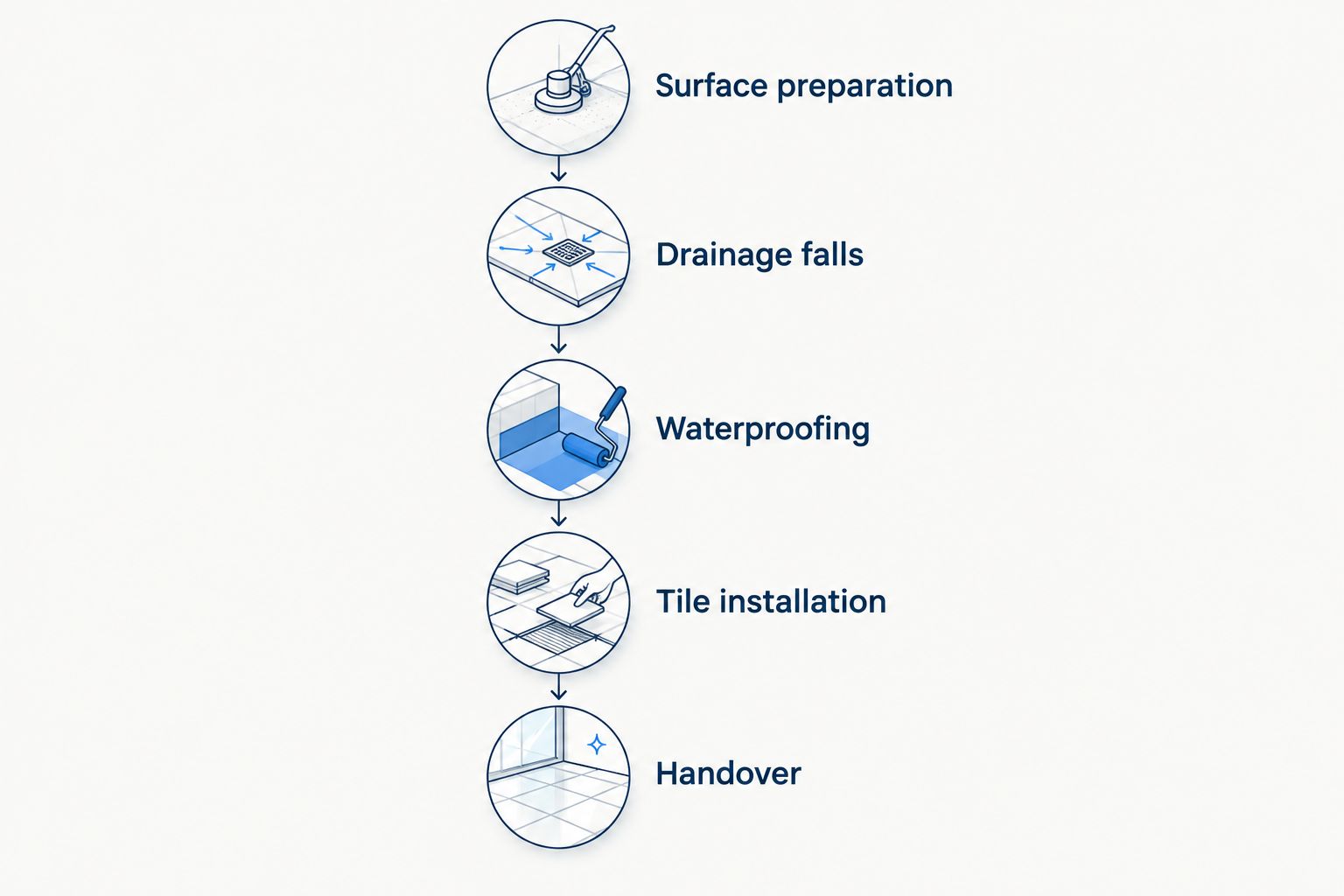
A practical bathroom scope follows this sequence:
- Surface preparation: Establish the condition of the surface receiving the system.
- Drainage falls: Set out how water reaches the intended outlet.
- Waterproofing: Name the responsible contractor and required records.
- Tile installation: Confirm compatible materials and installation details.
- Handover: Collect the agreed documentation and care instructions.
For your 2026 bathroom brief, make waterproofing responsibility a separate acceptance point. A statement that a contractor tiles bathrooms does not, by itself, define who carries out every part of the renovation.
Neither business gets a waterproofing win without a defined scope. Choose the proposal that identifies responsibility and the records you receive, rather than the one that simply promises a finished bathroom.
Installation quality is a tie until the details are agreed
Both candidates should face the same installation questions. A business name cannot tell you where cuts will fall, how exposed edges will finish or which grout suits the room.
For a kitchen splashback, discuss the visible edges, corners, power-point openings and the junction with the benchtop. Ask to agree the layout before installation starts. This gives you a clear reference for the finished work.
For bathroom and floor tiling, confirm:
- Tile direction and the starting point for the layout.
- Treatment of narrow cuts and prominent sightlines.
- Grout colour and suitability for the selected tiles.
- Trims or other finishes at exposed edges.
- Movement-joint locations and treatment.
- Adhesive suitability for the tile, surface and installation conditions.
The guide to tile adhesives for wet-area installations explains another part of that materials discussion. Ask the installer to identify the proposed system rather than selecting adhesive on a product name alone.
Treat installation as an unresolved comparison until you have specific answers. Request examples relevant to your job type, then discuss what those examples show about layout and finishing.
Confirmed access matters more than a broad Melbourne claim
North Melbourne, Port Melbourne and Richmond are named in the client’s service description. If your property is in Melbourne’s south-east, confirm the exact address before treating either contractor as a local fit.
A homeowner in Bentleigh planning a bathroom renovation should send the same location and access details as a homeowner in Richmond. Explain stairs, parking restrictions, occupied rooms and material storage. These details help define the job; they do not establish either business’s service coverage.
For a construction project, identify who coordinates the tiler with the plumber, electrician and other trades. Include the site contact and the process for approving changes.
In 2026, use confirmed attendance arrangements and a workable sequence as your location test. Do not choose a contractor solely because a suburb appears in marketing copy.
Pricing: compare written terms, not an assumed model
Do not assume either business uses a particular pricing model. Ask whether the proposal covers a defined scope, includes allowances or leaves parts of the work subject to assessment.
A clearly defined scope makes the commitment easier to understand. Allowances and provisional work leave decisions unresolved, so ask what triggers an adjustment and how you approve it.
Compare these items side by side:
| Quote item | What to establish |
|---|---|
| Tile supply | Whether you or the contractor supplies the tiles |
| Preparation | Which removal, repair and levelling tasks are included |
| Materials | Whether adhesive, grout, trims and sealants are included |
| Waterproofing | Whether it is included, excluded or arranged separately |
| Waste | Who handles removal and disposal |
| Changes | How extra work is described and approved |
| Completion | What inspection and handover steps are included |
For your 2026 decision, affordability means understanding the whole agreed job. A proposal with unresolved preparation or waterproofing responsibilities is not directly comparable with one that includes them.
Choose the better-defined offer before judging value. Ask for clarification wherever the descriptions differ. Do not fill the gaps with assumptions about what a tiler normally includes.
A defined handover gives both contractors the same finish line
Agree how you will inspect the completed work before accepting a proposal. Look at the layout, visible edges, grout finish and the junctions discussed during planning.
Ask for care information appropriate to the materials used. This is particularly important where natural stone, sealants or specialist cleaning requirements form part of the agreed job.
Keep handover practical:
- Record any items that need attention.
- Confirm who returns to address agreed items.
- Collect the waterproofing documentation specified in your scope.
- Ask when the installed materials can be used and cleaned, following the relevant instructions.
Handover is a shared standard, not an automatic win for either business. Put it in the scope so completion means more than the last tile being laid.
Final verdict: choose the proposal that fits your job
Choose Melbourne Tiling Group if you need its stated tiling services
Best for: homeowners and construction companies seeking residential or commercial wall and floor tiling. Its stated kitchen, bathroom and floor tiling scope makes it a relevant starting point. Confirm preparation, waterproofing responsibility and your property address before accepting a proposal.
Choose Melbourne Tiling VIC if its written proposal fits better
Best for: a homeowner whose job receives the clearer, better-matched proposal from this contractor. Choose it when its documented scope answers your requirements more effectively. That is a conditional selection rule, not an unverified claim about its services or workmanship.
One-glance scorecard
| Dimension | Winner |
|---|---|
| Stated service fit | The client business has an explicitly stated residential and commercial tiling scope |
| Preparation | The proposal with clear inclusions and a process for concealed defects |
| Waterproofing | The proposal naming responsibility and required records |
| Installation details | Tie until layout, materials and finishes are agreed |
| Location and coordination | The contractor confirming your address and access requirements |
| Pricing terms | The proposal with clear inclusions, exclusions and change approval |
| Handover | Tie until inspection and documentation are agreed |
FAQ
Is Melbourne Tiling Group better than Melbourne Tiling VIC?
There is no established overall winner in this comparison. The former explicitly lists residential and commercial wall and floor tiling; choose between the contractors using written preparation, waterproofing, installation and handover requirements.
Does bathroom tiling include waterproofing?
Do not assume bathroom tiling includes waterproofing. Ask whether waterproofing is included, who performs it and which records form part of handover.
How do I compare tiling quotes fairly?
Give both contractors the same written job brief and compare matching inclusions. Separate tile supply, preparation, waterproofing, installation, waste removal and changes before judging value.
What should I ask before booking kitchen splashback tiling?
Ask about surface preparation, layout, exposed edges and openings around fittings. Agree the finish at the benchtop junction and confirm who supplies tiles, grout and trims.
Can I assume either tiler covers Melbourne’s south-east?
Confirm your exact property address with each contractor. A broad Melbourne service description does not establish attendance arrangements for every suburb.
What should a floor tiling proposal include?
A floor tiling proposal should define the surface preparation, tile layout, installation materials and finishing work. It should also explain exclusions and how unexpected surface problems will be handled.
What should I receive when bathroom tiling is finished?
Receive the inspection and documentation agreed in your scope, along with relevant care instructions. Where waterproofing forms part of the job, collect the specified waterproofing records rather than relying on a verbal assurance.
One last thing
Ask each contractor to mark every task as included, excluded or awaiting inspection. Use 3 written documents to make your decision: the job brief, the proposal and the agreed changes. Compare 2 proposals against the same brief, and nominate 1 contact to approve variations.
That simple check exposes misunderstandings before work starts. A beautifully chosen tile cannot settle an argument about who was meant to prepare the wall.