No—not if you mean resin-bound engineered stone slabs or panels for a new outdoor installation: in 2026, these products fall under Australia’s engineered stone prohibition. If a supplier uses “engineered stone” to describe concrete pavers, porcelain or resin-free sintered material, check the actual product category, outdoor suitability and installation requirements before deciding whether it belongs in your Melbourne backyard.
- Is engineered stone worth it for outdoor paving in Melbourne? Not if it means prohibited resin-bound slabs or panels.
- Safe Work Australia distinguishes engineered stone from excluded materials such as concrete, porcelain and qualifying resin-free sintered stone.
- Choose outdoor paving by wet slip resistance, exposure, drainage and installation requirements—not a stone-look label.
- Compare the complete installation scope, including preparation, drainage, joints and ongoing care.
Is engineered stone worth it for outdoor paving in Melbourne?
Do not specify resin-bound engineered stone slabs or panels for new paving. Australia’s prohibition covers the manufacture, supply, processing and installation of engineered stone benchtops, panels and slabs. Calling a slab an outdoor paver does not establish that it is outside the prohibition.
Safe Work Australia’s engineered stone guidance distinguishes prohibited products from excluded categories, including concrete and cement products, porcelain, and sintered stone without resin. The supplier’s written product information matters more than the showroom label.
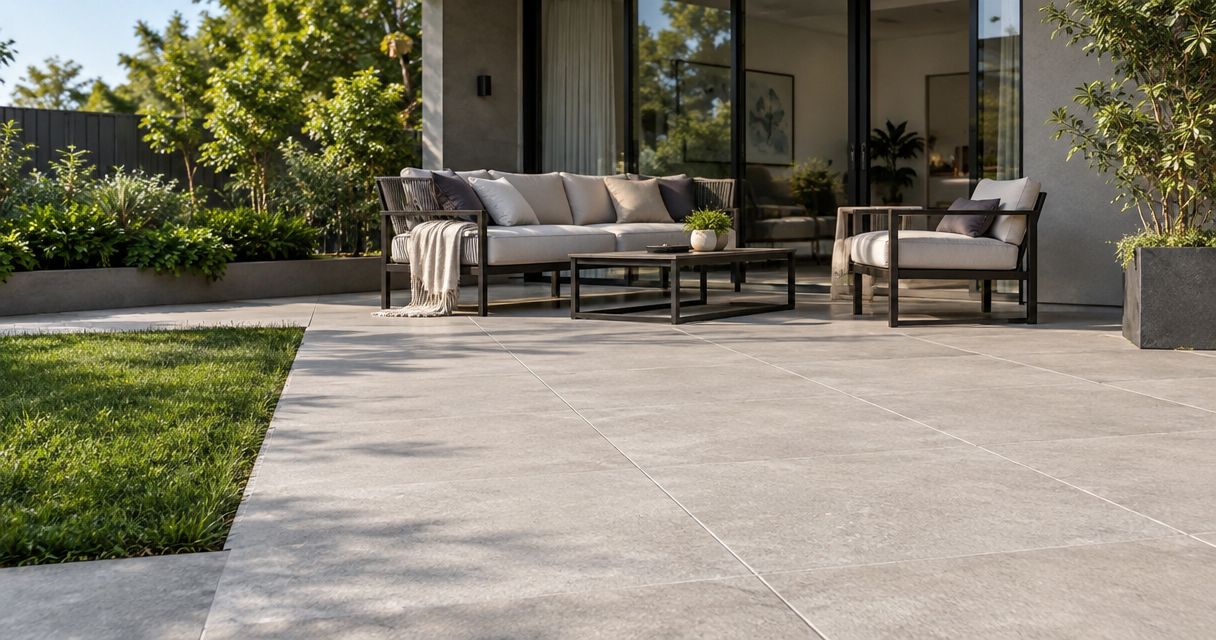
For alternatives, start with the guide to tiles for outdoor entertaining areas in Melbourne. Compare materials intended for external paving rather than adapting an indoor surface to an exposed patio.
| Material | Best for | Main advantage | Main limitation | Decision |
|---|---|---|---|---|
| Resin-bound engineered stone slabs or panels | Not suitable for a new paving specification | Consistent manufactured appearance | Subject to the engineered stone prohibition | Exclude from the shortlist |
| Outdoor-rated porcelain | Homeowners wanting a consistent stone-look finish | Many products do not require sealing | Finish, thickness and laying method still need checking | Consider a documented outdoor product |
| Concrete pavers | Paths and patios designed around modular paving | Available in formats suited to paving systems | Staining, surface wear and maintenance vary | Consider after checking the base design |
| Natural stone | Homeowners wanting natural colour and texture variation | Each piece has natural character | Porosity, sealing and cleaning needs vary by stone | Match the stone to its exposure |
| Resin-free sintered material | Projects needing a manufactured finish with documented external suitability | An excluded material category when it meets the relevant definition | The name alone does not prove paving suitability | Check composition and intended use |
Why this matters
A paving mistake affects more than appearance. An unsuitable surface can become difficult to maintain, while poor drainage leaves water where you walk or beside the house. A good-looking sample tells you little about the finished installation.
For a Melbourne renovation in 2026, separate three decisions: whether the product is lawful to supply and install, whether it suits outdoor use, and whether the proposed laying system suits your site. Passing one check does not answer the others.
This applies equally to a covered courtyard in Melbourne’s south-east and an exposed backyard elsewhere in the city. Describe the actual rain, sun and foot traffic rather than relying on the suburb name.
Resin-bound engineered stone: leave it off the paving shortlist
Resin-bound engineered stone became familiar through benchtops and interior surfaces. That familiarity does not make a slab suitable—or lawful—for a new outdoor paving job.
The material category is the first check, not the last. Ask the supplier to identify the composition and explain whether the product falls within the engineered stone prohibition. Do this before paying for material or arranging fabrication.
Do not treat a “low silica” description as approval. A sales term is not a legal classification, and outdoor exposure is a separate suitability question.
If you already have an unidentified engineered surface, do not cut, grind or remove it yourself. Work on existing engineered stone is subject to specific controls. Get advice from a contractor who understands those requirements before disturbing it.
Outdoor-rated porcelain: check the exact finish
Best for: homeowners wanting a consistent stone-look patio without choosing natural stone. Porcelain offers manufactured patterns and finishes, but only consider a product documented for the intended outdoor application.
The main benefit is a surface that generally has low water absorption. The trade-off is that a porcelain label does not tell you whether a particular finish suits wet foot traffic, steps or a pool edge.
Ask for slip-test information for the exact finish, not another product in the same range. Also confirm the required support, fixing method and edge details. A tile intended for a bonded installation is not automatically suitable for laying on another type of base.
Choose the documented outdoor specification, not the indoor tile that looks similar. Keep the product details with your installation paperwork so future repairs do not depend on remembering a showroom name.
Natural stone: choose the stone and maintenance together
Best for: homeowners who want natural variation and accept stone-specific care. Natural stone is quarried rather than manufactured into a uniform pattern. Differences between pieces are part of the material, not necessarily a defect.
The trade-off is maintenance. Absorption, staining, surface texture and cleaning requirements differ between stones and finishes. Ask whether sealing is recommended and what cleaning products the supplier permits.
Do not assume a sealer makes stone waterproof or slip-resistant. Those are different performance questions. Sealing also does not correct poor drainage or an unsuitable base.
Check a sample in daylight and wet it with the supplier’s permission. This helps you judge appearance, but it does not replace slip-test information. For a broader shortlist, compare natural stone for outdoor paving in Melbourne.
Concrete and resin-free sintered products: verify the specification
Concrete pavers are best for projects designed around a modular paving system. Their suitability depends on the paver, the intended loading and the base beneath it. A pedestrian courtyard and a vehicle crossing require different design decisions.
The practical advantage is choice in paving formats. The limitation is that surface finish, staining and maintenance vary, so inspect the actual product rather than relying on a generic concrete description.
Resin-free sintered material is best for projects with clear external-use documentation. Safe Work Australia identifies sintered stone without resin as an excluded category, but that exclusion is not a paving performance certificate.
Confirm the exact composition, intended use and installation method. If the supplier cannot explain whether the product is a tile, panel or paver—and how it must be supported—stop the selection there.
Why outdoor paving value varies
The useful comparison is the whole finished job, not just the surface material. These factors determine whether your paving specification is practical:
- Exposure: Tell the supplier whether the area is covered, exposed to rain or in direct sun. Ask for written suitability for those conditions.
- Wet foot traffic: Entrances, garden paths and pool surrounds need a finish selected for their actual use. Request relevant slip-test information.
- Base condition: Cracks, movement and uneven levels need assessment before a new surface covers them. The finish cannot repair the base.
- Drainage: Set levels and drainage details before laying. Water must not be trapped against doorways or directed towards the building.
- Installation system: Adhesive, bedding, grout and movement joints must suit the material and site. Treat them as a connected system.
- Ongoing care: Compare permitted cleaners, sealing requirements and replacement arrangements. A surface you cannot maintain sensibly is a poor fit.
For your 2026 project, ask each contractor to quote against the same scope. A proposal that excludes preparation or drainage is not equivalent to one that includes them.
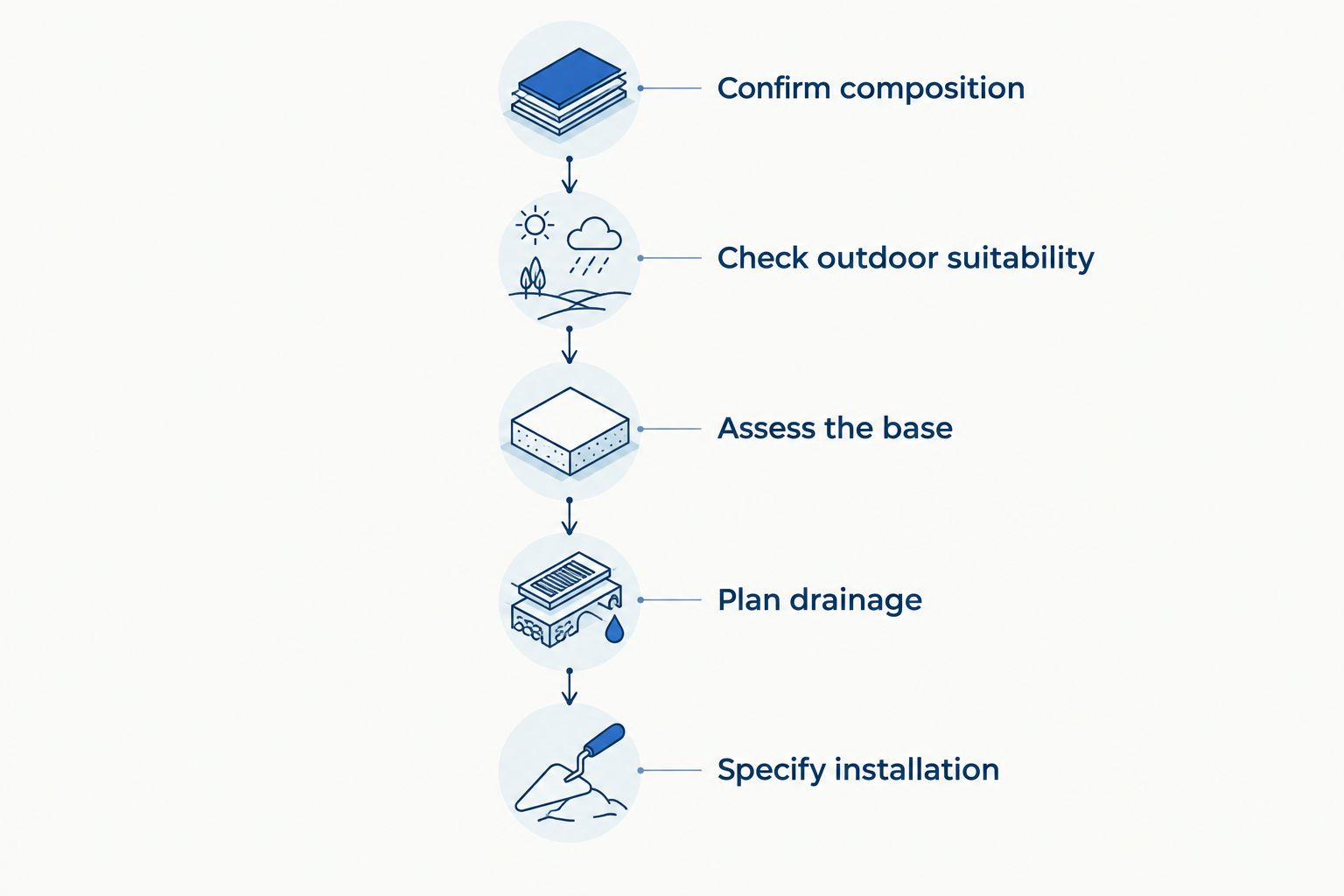
How do you plan a durable outdoor paving installation?
Follow this sequence before booking the laying work. It prevents material selection from getting ahead of the checks that determine whether the surface will work.
- Confirm composition. Obtain the product name, composition and written classification. Resolve any engineered stone ambiguity before ordering.
- Check outdoor suitability. Confirm the intended application, finish, relevant slip testing and exposure limits. Keep the documents for the exact product.
- Assess the base. Have the existing slab or proposed base assessed for condition, support and compatibility with the laying method.
- Plan drainage. Resolve finished levels, door thresholds, outlets and any waterproofing requirements. An exposed terrace over a room needs different detailing from paving on the ground.
- Specify installation. Agree on bedding or adhesive, joints, edges, curing requirements and handover care before work starts.
Ask for exclusions in writing as well. Removal, disposal, repairs, drainage changes and waterproofing should not remain assumptions hidden behind a single installation figure.
Melbourne Tiling Group provides residential and commercial wall and floor tiling services. Melbourne Tiling Group suits Melbourne homeowners seeking wall and floor tiling installation. For an outdoor project, confirm the proposed material and project scope directly; a general tiling service description is not proof that every paving system is offered.
Discuss your tiling project
Confirm the material, site conditions and installation scope before committing to your project.
Does a covered patio make engineered stone suitable?
A covered patio does not remove the engineered stone prohibition. Shelter also does not establish a product’s suitability for external moisture, temperature changes or wet foot traffic.
Choose a lawful product with written approval for the actual application. Check exposed edges and wind-driven rain, not just the roof overhead.
Can you use the same surface indoors and outdoors?
A matching appearance does not require an identical surface finish. Some ranges offer different finishes, but you must confirm each product’s intended use rather than assume the indoor specification carries outside.
Resolve the doorway detail with the installer. Matching colour is useful; managing water and finished levels is essential.
Is a stone-look product easier to maintain than natural stone?
Maintenance depends on the exact material and finish, not the stone-look description. Outdoor porcelain generally avoids the sealing requirements associated with some natural stone, but joints and textured surfaces still need cleaning.
Ask for the care instructions before choosing. Compare tasks you will actually do, including cleaning around furniture, garden beds and cooking areas.
FAQ
Is engineered stone worth it for outdoor paving in Melbourne in 2026?
Resin-bound engineered stone slabs and panels are not an option for a new paving installation under Australia’s engineered stone prohibition. If a supplier means concrete, porcelain or resin-free sintered material, assess that exact product separately.
Does the engineered stone prohibition include concrete pavers?
Concrete and cement products are excluded categories under Safe Work Australia’s engineered stone guidance. You still need a paver and installation system suited to the intended outdoor use.
Is porcelain better than natural stone for my patio?
Porcelain suits homeowners wanting a consistent manufactured finish, while natural stone suits those wanting natural variation. Compare wet slip resistance, installation requirements and maintenance before choosing either.
Can I use an indoor stone-look tile outside?
Use an indoor stone-look tile outside only when its manufacturer documents suitability for that application. Appearance alone does not establish wet slip resistance or compatibility with the proposed laying system.
Does sealing make natural stone paving waterproof?
Sealing does not make a paving installation waterproof. Waterproofing, where required, is a separate system, and drainage must still be designed correctly.
What should I ask a paving supplier before ordering?
Ask for the exact composition, outdoor-use documentation, slip-test information, installation instructions and maintenance requirements. Resolve unclear engineered stone terminology before committing to the material.
Can Melbourne Tiling Group help with my tiling plans?
Melbourne Tiling Group provides residential and commercial wall and floor tiling services in Melbourne. Confirm the material, outdoor application and installation scope directly before including the business in your project plan.
One last thing
Ask to see the product documents before taking the sample home. A sample helps you choose colour and texture; it cannot prove legal classification, outdoor suitability or the correct laying method.
Keep those documents with your 2026 project records, alongside the agreed installation scope and care instructions. That is more useful at handover than a vague promise that the surface is “outdoor stone”.